
How to Identify Real Cactus Leather: 7 Things to Check Before You Buy
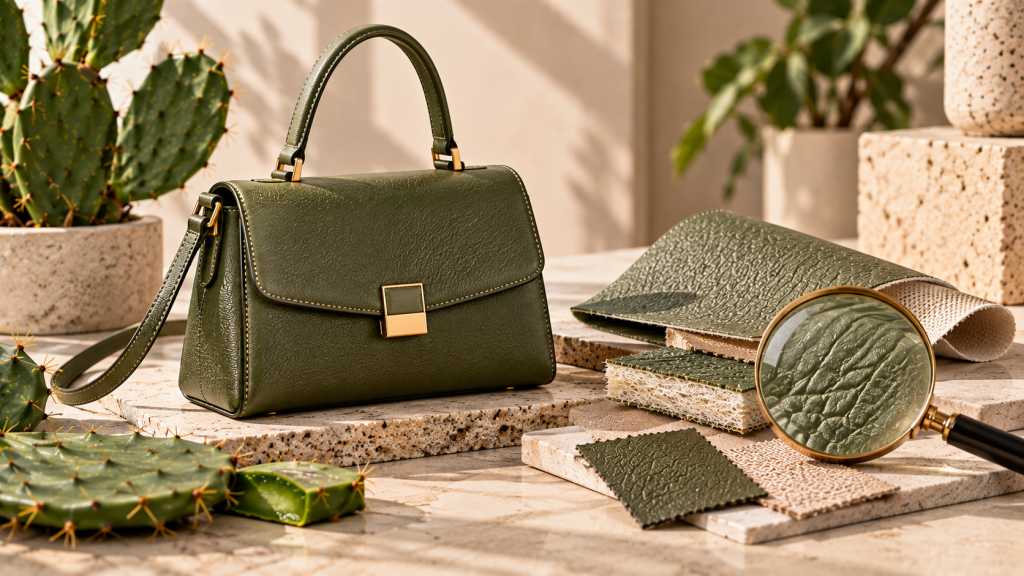
Not every bag labelled “cactus leather” tells you the complete material story. The term can refer to different formulations, backing layers, coatings and manufacturing systems, so the label alone is not enough to judge what is actually in the finished material.
If you are buying a cactus leather handbag, the smarter approach is to look beyond the word “cactus” and check what the brand actually discloses.
Quick answer: To identify real cactus leather, check the material description, cactus-derived content, supplier or material manufacturer, backing layer, binders or coatings, care instructions and supporting documentation. Do not rely on colour, texture or the word “cactus” alone. There is no reliable home test that can prove composition just by touching or looking at a bag.
What Does “Cactus Leather” Actually Mean?
Cactus leather is an engineered leather alternative that uses cactus-derived material as part of a finished composite, rather than being a simple sheet of dried cactus.
The important word here is “part.”
Commercial plant-based leather materials can contain several layers or components. Depending on the formulation, these can include processed plant material, a polymer or bio-based binder, a textile backing and surface coatings or finishes. A scientific review of leather alternatives notes that plant-based leathers vary considerably in their bio-based content and may use synthetic binders and coatings to achieve the required durability and performance.
That means the phrase “made from cactus” does not automatically tell you the complete composition.
This is not necessarily a problem.
A material can still be vegan and plant-based while containing a binder, backing or coating. The important issue is whether the description is transparent enough for you to understand what you are buying.
The same principle applies to other plant-based leather alternatives made using materials such as pineapple, apple, grape or other agricultural inputs.
The plant ingredient is only one part of the material story.
How Can You Tell If Cactus Leather Is Genuine?
You cannot reliably verify cactus leather simply by looking at it or feeling its surface; documentation and material disclosure are much more useful.
Cactus leather is designed to behave like a practical leather alternative. It can have a smooth, embossed or grain-like surface, depending on how the finished material is manufactured.
That creates an obvious problem for buyers.
A synthetic leather can be made to look extremely similar.
Likewise, a photograph cannot tell you whether the backing is cotton, polyester or another textile, or whether a polymer binder has been used.
So instead of trying to perform a DIY “cactus test”, use a traceability test.
Ask:
| What to check | What you want to see |
|---|---|
| Material name | A clear explanation of what the brand means by cactus leather |
| Plant input | Identification of the cactus-derived material |
| Material supplier | Supplier or branded material manufacturer where appropriate |
| Composition | Disclosure of the major material components |
| Backing | Information about the textile or structural backing |
| Binder/coating | Clear disclosure where polymer binders or coatings are used |
| Care | Specific instructions for maintaining the finished material |
| Documentation | Certification or technical information where a specific claim requires verification |
A good brand does not need to claim that its material is perfect.
It needs to explain it clearly.
What Should a Brand Disclose About Cactus Leather?
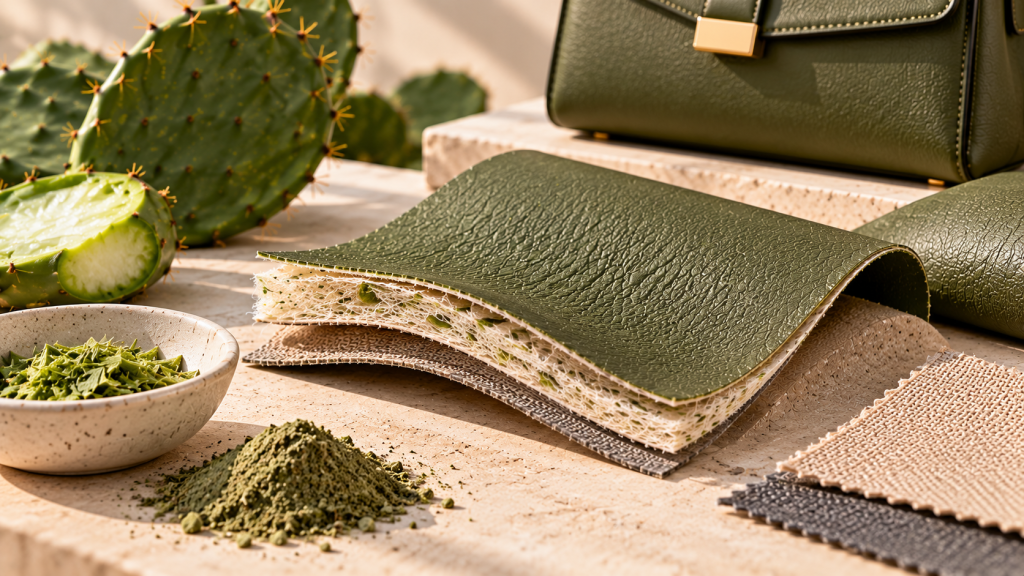
A trustworthy material description should tell you enough about the finished material to distinguish a specific formulation from a vague “eco leather” claim.
Start with the source.
Some cactus leather materials are associated with specific commercial material suppliers. For example, Coneli identifies its cactus material as being sourced from Desserto in Zacatecas, Mexico.
That level of information is useful because it gives the buyer something concrete to investigate.
Next, look at composition.
The phrase “plant-based” can mean different things across materials. A recent review of leather alternatives found significant variation in bio-based content between different plant-based leather formulations.
Then look at what sits behind the visible surface.
A leather alternative is a constructed material. The backing can affect strength, flexibility, dimensional stability and how the material behaves during stitching and everyday use.
Finally, look at care instructions.
This is an underrated test.
A manufacturer or brand that understands its material should be able to explain how it should be cleaned, stored and protected. Care guidance for cactus-based materials commonly recommends gentle cleaning and avoiding harsh solvents, while prolonged direct sunlight can be a concern for some finished materials.
Is Cactus Leather Always 100% Plant-Based?
No, you should not assume that cactus leather is 100% plant-derived simply because cactus is the primary material story.
This is probably the most important distinction for anyone researching plant-based leather.
A finished cactus leather material can contain cactus-derived material together with binders, coatings and backing fabrics. Scientific literature specifically notes that plant-based leather alternatives can rely on synthetic binders or coatings to achieve functional performance.
Some commercial suppliers and brands disclose specific bio-based percentages for their own materials. Those figures should be treated as formulation-specific, not as a universal specification for every product described as cactus leather.
So be careful with statements such as:
- “100% cactus leather”
- “completely plant-based”
- “plastic-free”
- “fully biodegradable”
- “zero synthetic content”
The exact meaning depends on the finished material and the evidence behind the claim.
A better question is:
“What is this particular material made from?”
That question produces a much more useful answer than simply asking whether something is “eco-friendly.”
7 Red Flags When Buying a Cactus Leather Bag
The biggest red flag is not a missing certification; it is a material claim that gives you no meaningful information about what the product actually contains.
1. The product only says “cactus leather”
A product description that stops at “cactus leather” leaves important questions unanswered.
It does not necessarily mean the product is misleading. It simply means you do not have enough information to understand the formulation.
2. “Plant-based” is used without explanation
Plant-based tells you something about the origin of at least part of the material, but it does not automatically tell you the complete composition.
Look for a material description rather than just a sustainability adjective.
3. “Plastic-free” is claimed without evidence
This deserves particular scrutiny.
Current plant-based leather materials can use polymer binders, coatings or backing layers. The exact formulation matters.
If a brand makes a strong plastic-free claim, ask what the finished material is made from.
4. No information about the backing
The visible surface is only part of a handbag material.
Backing affects construction, stitching and handling. If a brand provides detailed material information, backing should not be treated as an irrelevant technicality.
5. No care instructions
A premium material should come with practical ownership information.
For example, some cactus-based material care guidance specifically warns against solvents such as alcohol and acetone and recommends gentle, water-based cleaning methods.
6. Sustainability claims are bigger than material claims
Be cautious when a product page spends more space saying “eco-friendly” than explaining the actual material.
Sustainability is broader than the raw material alone.
It includes composition, manufacturing, durability, repairability, packaging and eventual disposal.
7. The brand cannot answer basic material questions
You do not need to interrogate a brand with a laboratory questionnaire.
But if you ask what the cactus material is, where it comes from and what other major components are present, the brand should be able to give you a meaningful answer.
If it cannot, compare the information available before buying.
What Is the Difference Between a Genuine Material Claim and Greenwashing?
A genuine material claim is specific enough to be checked; greenwashing usually relies on broad environmental language without enough supporting detail.
Consider the difference:
| Vague claim | More useful information |
|---|---|
| “Eco-friendly leather” | “Cactus-derived material used in the outer material” |
| “Plant-based leather” | Plant source plus composition information |
| “Sustainable cactus leather” | Material supplier, formulation or supporting documentation |
| “Plastic-free” | Clear evidence explaining the finished material composition |
| “Biodegradable” | Explanation of which component is biodegradable and under what conditions |
| “Vegan leather” | Clear distinction between animal-free status and plant-derived content |
The right response to incomplete information is not automatically “fake.”
It is:
“I need more information before I can verify the claim.”
That distinction matters.
A brand may use a legitimate cactus-based material but simply provide poor product-page information. Conversely, a beautifully written sustainability story does not prove a material claim by itself.
Does Touch or Appearance Prove Cactus Leather Is Real?
No, appearance and hand-feel can help you assess quality, but they cannot prove that a material contains cactus-derived content.
A cactus leather handbag can have a soft, smooth or grain-textured surface. Similar finishes can also be produced on conventional synthetic leather.
This is why visual inspection should be treated as a quality check, not a composition test.
You can still inspect:
- Surface consistency
- Edge finishing
- Stitching
- Seam construction
- Handle attachment
- Hardware
- Lining
- Shape retention
- Surface cracking or peeling
- Colour consistency
These things tell you whether the finished bag has been constructed carefully.
They do not tell you exactly what percentage of the sheet came from cactus.
That requires information from the material supplier, manufacturer or appropriate documentation.
How Should You Verify a Cactus Leather Claim Before Buying?
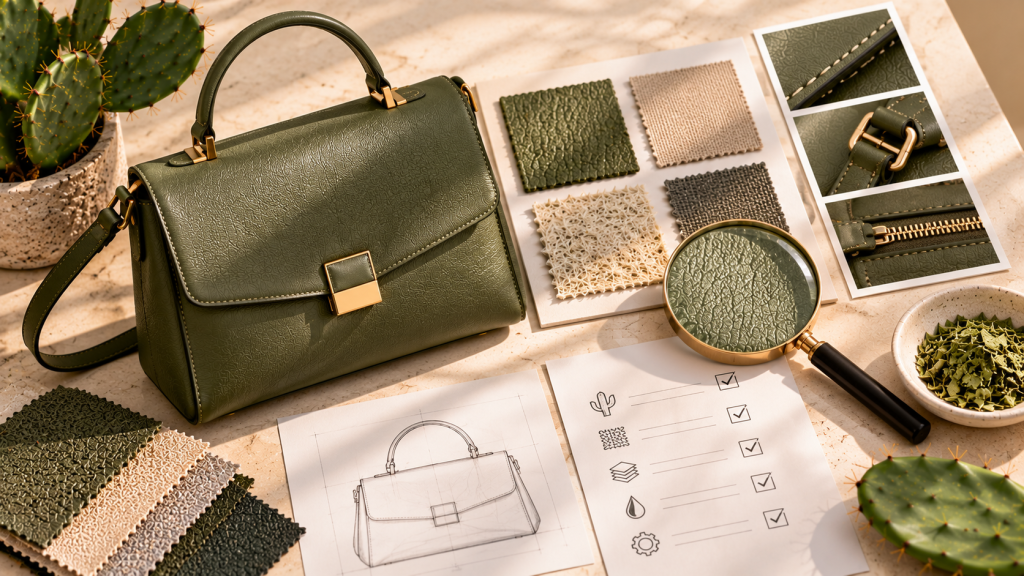
The simplest verification method is to ask four direct questions and judge the quality of the answers.
Question 1: What cactus material are you using?
Ask for the material name or supplier where the information can reasonably be disclosed.
Question 2: What is the material composition?
Ask whether the material contains a backing, binder, coating or other major components.
Question 3: Is the plant-derived content documented?
If the brand makes a specific percentage claim, ask what documentation supports it.
Question 4: How should the finished product be cared for?
A clear care guide demonstrates that the brand understands the practical behaviour of the material.
You can also look for third-party certifications where the brand makes claims that require independent verification. Certification can be useful, but its relevance depends on what exactly has been certified.
For example, the USDA BioPreferred programme concerns biobased content, so a certification connected to biobased content should not automatically be interpreted as proof of every other environmental claim made about a product.
Cactus Leather Buyer Checklist
Before buying a cactus leather handbag, check the material information first and the marketing language second.
Use this quick checklist:
- Does the product clearly identify the material as cactus-based?
- Does the brand explain what it means by cactus leather?
- Is the cactus source or material supplier disclosed where appropriate?
- Is the composition explained?
- Is the backing material identified?
- Are binders or coatings disclosed when relevant?
- Are strong claims such as “plastic-free” supported?
- Are care instructions provided?
- Is there supporting certification or documentation for specific claims?
- Does the brand answer material questions directly?
If most of these boxes are answered clearly, you have much better information to make your decision.
If several are unanswered, do not automatically assume the product is fraudulent.
Simply recognise that you have less evidence than you should have.
The Bottom Line: How to Identify Cactus Leather
To identify cactus leather properly, look for material transparency rather than trying to identify it by sight, smell or touch.
Cactus leather is not simply a cactus leaf turned into a handbag. It is an engineered material that can combine cactus-derived inputs with binders, backing materials and surface treatments.
The most useful questions are therefore straightforward:
Where does the material come from? What is it made from? What supports it? What coatings or binders are used? And can the brand explain those claims clearly?
That is a much stronger way to evaluate cactus leather than trusting the word “cactus” printed on a product page.
For a deeper understanding of the material itself, start with [What Is Cactus Leather? A Complete Guide to Cactus-Based Materials] and then explore [Vegan Leather vs Plant-Based Leather: The Difference].
If you are specifically comparing cactus leather with conventional leather alternatives, read [Cactus Leather vs Traditional Leather: What Really Changes?].
For the practical side of choosing a finished handbag, [How to Choose a Vegan Leather Handbag That Actually Lasts] covers construction, stitching, hardware and everyday use.
And once you own one, [Cactus Leather Care: How to Clean and Store Your Bag] explains the basics of cleaning and storage.
At ANOVYA, the material story is part of a larger approach to plant-based fashion: the material should be explained honestly, while the finished product still has to work as a handbag you can actually use.
Frequently Asked Questions
How can I identify real cactus leather?
You cannot reliably identify cactus leather by appearance alone. Check whether the brand explains the cactus-derived material, composition, backing and supplier or material manufacturer. If a specific bio-based percentage or certification is claimed, look for supporting documentation. The most reliable evidence comes from material disclosure rather than a DIY touch or smell test.
Is cactus leather actually made from cactus?
Yes, cactus-based leather materials use processed cactus-derived material as part of the finished material. However, the finished sheet is typically an engineered composite rather than pure cactus. Depending on the formulation, it may also contain binders, coatings and backing materials.
Is cactus leather 100% plant-based?
Not necessarily. “Cactus leather” does not by itself establish that every component is plant-derived. Plant-based leather formulations can include polymer binders, coatings and textile backing. The exact composition depends on the specific material, so check the manufacturer’s material information rather than assuming the entire finished sheet is plant-derived.
Can you test cactus leather at home?
There is no simple, reliable home test that can prove the cactus content of a finished handbag without potentially damaging it. Burning, cutting or applying solvents is not a sensible authenticity test. Instead, check material documentation, supplier information, composition and certification where relevant. Visual and touch inspection should be used for quality, not proof of origin.
Does expensive-looking cactus leather mean it is genuine?
No. Appearance, texture and finishing can indicate how well a handbag has been constructed, but they do not prove its material composition. A convincing surface can be produced on several types of leather alternatives. Look at the manufacturer’s material disclosure and supporting information instead of using appearance as the authenticity test.
What should a cactus leather brand disclose?
A useful material description should explain the cactus-derived input and, where relevant, the backing, binder, coating and supplier or material manufacturer. If the brand makes specific biobased, biodegradable or certification claims, the supporting basis should also be clear. Detailed care instructions are another useful sign that the brand understands the finished material.
Is lack of certification proof that cactus leather is fake?
No. Lack of a certification does not automatically mean a cactus leather claim is false. Certification is only one form of evidence, and different certifications verify different characteristics. If certification is not provided, focus on whether the brand gives clear composition, sourcing and material information that allows you to understand the product.
Anovya Life Style
Crafted for Conscious Living