
Cactus Leather vs PU Leather: What Are You Actually Buying?
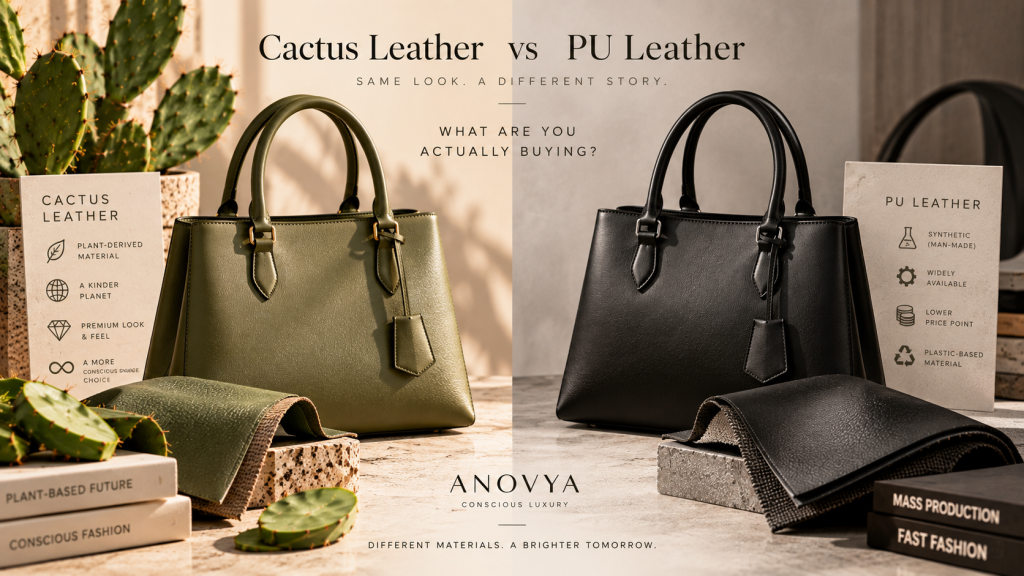
If a handbag says “vegan leather”, that still does not tell you what the material actually is.
It could be conventional polyurethane (PU) leather. It could contain plant-derived material. It could be a composite with a plant-based component, synthetic binder and textile backing. The label alone is not enough.
That is where the cactus leather vs PU leather conversation gets interesting.
Quick answer
Cactus leather vs PU leather is not simply a choice between “natural” and “plastic.” PU is a synthetic polyurethane-based material, while cactus leather uses cactus-derived material within an engineered leather-like construction. The exact composition, backing, coating, durability and manufacturing process matter more than the marketing name alone.
Cactus Leather vs PU Leather: What Is the Actual Difference?
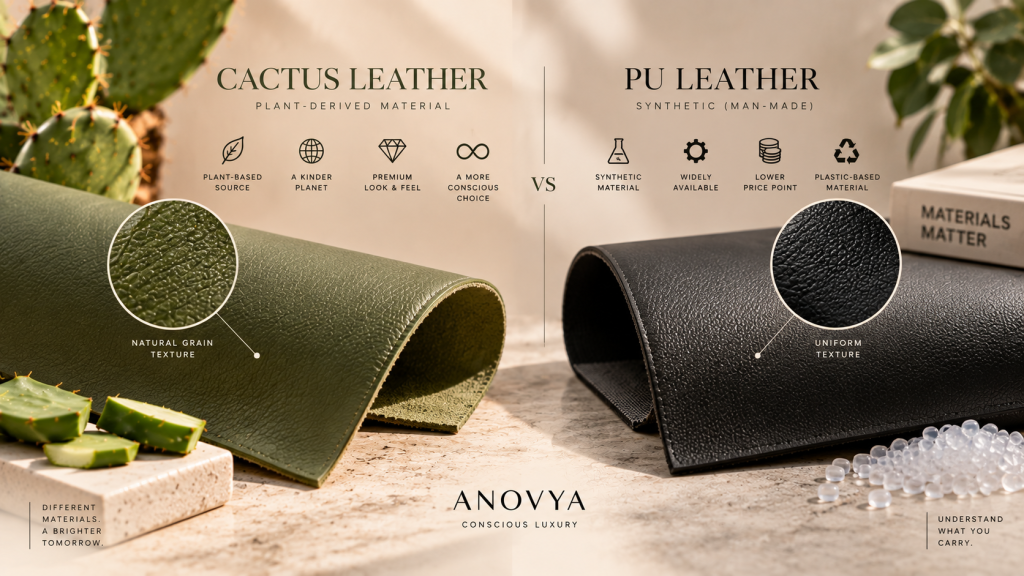
The biggest difference is the material source: PU leather is primarily polymer-based, while cactus leather incorporates cactus-derived material into an engineered composite.
PU leather is generally produced by applying polyurethane onto a textile or other backing. It became popular because manufacturers can produce consistent surfaces in different colours, textures and finishes at scale.
Cactus leather belongs to the newer family of plant-based leather alternatives.
But there is an important detail that gets lost in Instagram captions: plant-based does not automatically mean 100% plant-derived.
Recent reviews of leather alternatives show that commercial plant-based materials can contain plant fibres or biomass alongside polymer binders, coatings and textile backings. These components affect flexibility, strength, water resistance, durability and end-of-life behaviour.
So when you compare two bags, don’t stop at:
“This one says cactus.”
Ask what the finished material is actually made from.
That is the more useful question.
Is Cactus Leather Actually Plastic-Free?
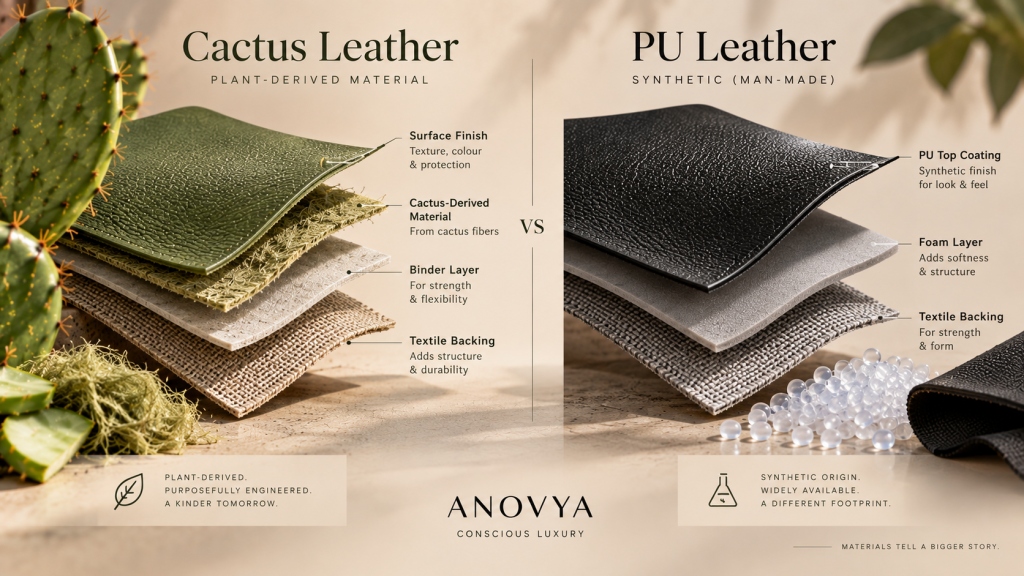
You should not assume cactus leather is plastic-free unless the manufacturer provides specific composition information proving it.
This is one of the biggest misunderstandings around plant-based leather.
A leather alternative can begin with a plant-derived raw material and still use a polymer coating or synthetic backing to achieve the performance expected from a handbag.
That isn’t necessarily a failure.
A handbag has to bend thousands of times, hold its shape, resist everyday abrasion, handle occasional moisture and survive hardware attachment points. Material engineers often use multiple layers to achieve those properties.
Recent scientific reviews specifically identify synthetic binders and coatings as an important trade-off in plant-based leather development. They can improve performance while reducing the overall bio-based proportion of the finished composite.
So the better question is not:
“Is it plant-based?”
It is:
“How much of the finished material is plant-derived, and what else is used to make it perform?”
That distinction matters.
Cactus Leather vs PU Leather: How Do They Feel?
Both materials can be engineered to look smooth, textured, structured or soft, so appearance alone is a poor way to identify them.
A good handbag material is not judged by the word printed on its product page.
Run your fingers across the surface.
Look at the grain.
Flex the material gently.
Check how the edge has been finished.
Look at the reverse side if it is accessible.
Then look at the construction around the handles and corners.
The surface finish can dramatically change how a material feels. A heavily finished plant-based composite may feel very different from another cactus-based material, just as two PU materials can feel completely different from each other.
This is why material construction and finishing matter alongside the raw material.
For a premium handbag, you should also look beyond the sheet itself.
A beautiful material with weak stitching is still a badly made bag.
Does Cactus Leather Last Longer Than PU Leather?
There is no universal lifespan number for either material because construction, formulation, usage and finishing can change performance significantly.
This is where many online comparisons become too simplistic.
You will find claims that PU lasts two years, five years or much longer. You will also find cactus leather brands claiming ten years or more.
Those numbers should not automatically be treated as universal specifications.
Scientific literature points to a wider issue: standardised testing for bio-based leather alternatives is still developing, and performance can vary significantly between formulations.
For a handbag buyer, therefore, look at the things you can actually inspect:
| What to inspect | Why it matters |
|---|---|
| Surface finish | Affects abrasion, staining and appearance |
| Backing | Helps determine dimensional stability and strength |
| Flexibility | Excessive stiffness can create stress at folds |
| Stitching | Poor seams can fail before the material does |
| Handle attachment | High-load area that deserves reinforcement |
| Hardware | Weak hardware can make a premium bag feel disposable |
| Edge finishing | Protects exposed material and improves longevity |
| Care instructions | Incorrect cleaning can damage the surface |
Material is only one part of durability.
Construction decides what happens when you actually live with the bag.
What Does PU Leather Do Better?
PU leather remains attractive because it is established, scalable, consistent and available in a huge range of finishes and price points.
That deserves to be acknowledged.
PU technology has been used extensively across fashion, footwear, furniture, automotive interiors and accessories. Manufacturers understand how to process it, texture it and reproduce finishes consistently.
For a buyer working with a strict budget, that can matter.
A PU handbag can also be perfectly functional for a particular use case.
The problem comes when the words “vegan”, “eco” or “leather alternative” are treated as complete material specifications.
They aren’t.
PU is a specific material system.
Vegan is a broader category.
Plant-based is another description.
Those terms overlap, but they are not interchangeable. Recent materials research similarly separates synthetic vegan leather from bio-based and plant-fibre alternatives.
What Does Cactus Leather Bring to the Table?
Cactus leather gives brands and consumers a way to incorporate plant-derived material into a premium leather-alternative product rather than relying exclusively on conventional synthetic leather systems.
The cactus itself is only the beginning.
The real material is the result of processing, formulation, backing, finishing and manufacturing.
That is why two products both called “cactus leather” should not automatically be assumed to perform identically.
At ANOVYA, cactus-based material is central to the product story, with the finished handbags combining plant-based material with hand finishing and detailed construction. The brand currently lists cactus leather handbags from about ₹6,699 to ₹8,499, depending on the model.
The price difference compared with mass-market synthetic bags isn’t simply about the word cactus.
You are also paying for:
- material selection
- pattern cutting
- construction
- hardware
- finishing
- stitching
- quality control
- smaller production runs
- design
That is an important distinction when comparing prices.
How Much Does a Cactus Leather Bag Cost in India?
A realistic current retail reference for premium cactus-leather handbags in India is roughly ₹6,700–₹8,500, while lower-priced synthetic alternatives can sit far below that range.
For example, current ANOVYA listed prices include structured handbags at ₹6,699 and several tote designs at ₹8,499.
| Bag category | Indicative India price | What you’re generally paying for |
|---|---|---|
| Entry-level synthetic/PU bag | ₹800–₹2,500 | Low-cost material and mass production |
| Better-finished PU bag | ₹2,500–₹5,000 | Better construction, hardware and finishing |
| Premium cactus-based handbag | ₹6,700–₹8,500+ | Plant-based material, design and premium construction |
| Luxury plant-based handbag | ₹15,000–₹25,000+ | Higher-end design, craftsmanship and positioning |
These are indicative market bands, not universal material prices. Construction, brand positioning, hardware, lining and production volume can move the final price considerably.
A useful example:
1 premium cactus-leather handbag × ₹6,699–₹8,499 = approximately ₹6,700–₹8,500 per bag.
The interesting part is that material price alone doesn’t explain the retail price.
The bag is a finished product.
So, Cactus Leather or PU Leather?
The answer depends on what you value, but the most important step is to look past the front-of-pack marketing language and understand the actual material construction.
Choose based on:
If price is the priority:
PU generally gives manufacturers a broader low-cost supply base and established processing routes.
If plant-derived material is important:
Look for the exact plant source and, where available, disclosed bio-based content.
If durability matters:
Look at the entire handbag construction rather than assuming the material name guarantees longevity.
If sustainability matters:
Ask about the backing, coating, binder, manufacturing process and expected useful life rather than accepting “plant-based” as a complete environmental assessment.
If luxury matters:
Inspect finishing, hardware, stitching, silhouette and how the material actually feels.
The most sustainable bag is not necessarily the one with the most impressive material story.
It is a product that is well made, used frequently, cared for properly and kept for a long time.
That is also why ANOVYA’s sustainability approach places emphasis on longevity, repairability, small-batch production and responsible materials rather than treating the plant source as the entire story.
5 Questions to Ask Before Buying Cactus Leather
1. Is cactus leather 100% cactus?
Not necessarily. Commercial plant-based leather can contain plant material alongside polymer binders, coatings and textile backings. Ask the brand for the material composition instead of assuming that “cactus leather” means the entire finished sheet is cactus-derived.
2. Is PU leather vegan?
Yes, PU leather can be vegan because it does not use animal hide. But “vegan” describes the absence of animal-derived material; it does not mean that the material is plant-based. PU is a polyurethane-based synthetic material.
3. Is cactus leather more sustainable than PU?
It can have a lower-impact material profile, but you need to assess the exact formulation. Plant-derived content, synthetic coatings, backing materials, manufacturing energy, durability and end-of-life all affect the overall picture.
4. Is cactus leather expensive in India?
Premium cactus-leather handbags currently commonly sit in the several-thousand-rupee range. For example, current ANOVYA listed handbags are around ₹6,699–₹8,499, depending on the model.
5. Does cactus leather feel like real leather?
It can be engineered to deliver a leather-like appearance and tactile experience, but it is not animal leather. Texture, softness and flexibility depend on the particular material formulation, surface finish and construction.
6. Should I buy cactus leather instead of PU?
Compare the actual product rather than choosing from the label alone. Check composition, construction, price, care requirements, durability information and the manufacturer’s transparency. The right material depends on what you want the bag to do and how long you intend to use it.
The Bottom Line
Cactus leather vs PU leather is not a simple battle between “good” and “bad” materials.
PU remains a mature, widely available synthetic material. Cactus leather represents a newer direction in plant-based material development, but its environmental and performance profile depends on how the finished material is engineered.
So next time you see “vegan leather”, don’t stop there.
Ask the better question:
What is actually inside it?
And if you’re considering a cactus leather handbag, look at the material, construction and craftsmanship together. That’s where the real difference is made.
Explore what is cactus leather before comparing materials, or continue with how to choose a vegan leather handbag if you’re already shopping.
For a closer look at ANOVYA’s current cactus leather collection, explore our cactus leather handbags.