
How Vegan Leather Is Shaping Modern Handbag Design
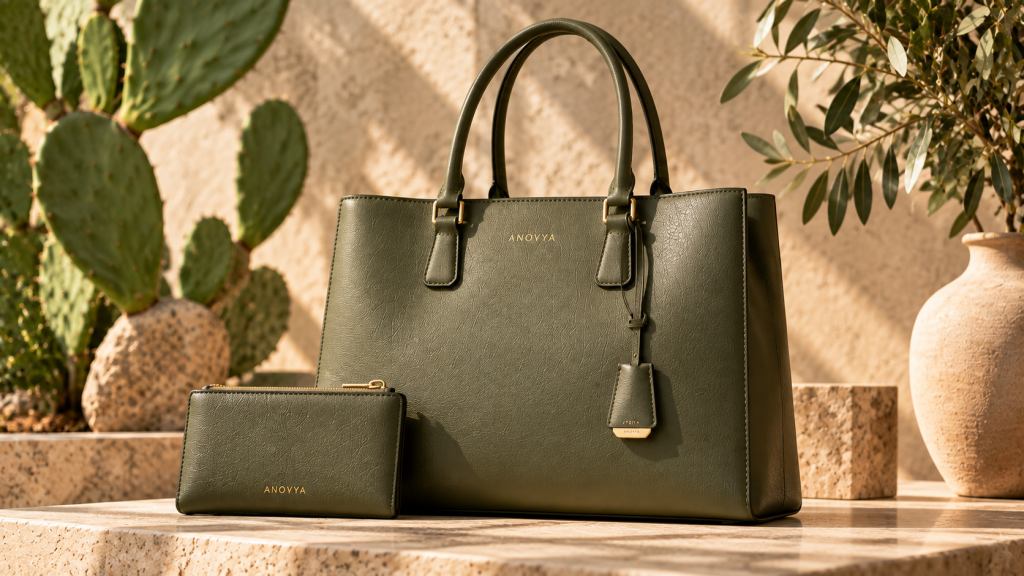
A handbag is not just a container. Its material determines how it looks, how it bends, how it holds a silhouette, how the surface feels in your hand and even how hardware and stitching appear against it. That is why vegan leather handbag design is becoming as much about material development as it is about fashion.
But vegan leather is not one single material. Different constructions can have different surfaces, backings, flexibility and performance. The interesting shift is that designers are no longer treating vegan leather simply as a substitute for traditional leather. They are using its characteristics to create different shapes, finishes and visual identities.
Quick answer: Vegan leather is shaping modern handbag design by giving designers flexibility across texture, colour, structure and finish while opening the category to non-animal material choices. The material can support structured totes, softer shoulder bags, wallets and other accessories, but the final result depends on the specific material, construction, reinforcement, hardware and craftsmanship.
How Is Vegan Leather Changing Handbag Design?

Vegan leather is changing handbag design by making the material itself part of the design language rather than simply a replacement surface.
A handbag designer has to think about several things simultaneously:
- Structure — should the bag stand upright or fall softly?
- Hand feel — should the surface feel smooth, grainy, soft or substantial?
- Flexibility — should the panels bend easily or retain their form?
- Texture — should the grain be subtle or visually pronounced?
- Finish — should the surface be matte, satin-like or more reflective?
- Construction — how will the material behave around handles, corners and seams?
Recent handbag material-development work points to exactly this shift: surface character, grain, flexibility, backing, thickness and recovery all influence the final silhouette rather than colour alone.
This matters because the same handbag shape can look completely different when made from two different materials.
A stiff, fine-grain surface can make a tote look architectural.
A softer material can make the same tote look relaxed.
The pattern has not changed. The material has changed the personality of the bag.
Why Does Material Matter So Much in a Vegan Leather Handbag?
Material matters because a handbag is a three-dimensional object, and the sheet material has to behave correctly around every curve, fold and stress point.
Consider a structured tote.
The designer may want:
- defined corners
- clean vertical panels
- a stable base
- handles that remain upright
- minimal surface wrinkling
A softer shoulder bag has a different requirement. It may need controlled drape so that the body develops a relaxed shape rather than looking rigid.
This is why material selection and product construction need to be considered together. Current handbag-development guidance specifically highlights thickness, backing, softness, recovery and intended structure as material-selection factors.
The material also works with everything around it.
A beautiful outer surface can still look ordinary if:
- the edge finishing is inconsistent
- the stitching is uneven
- the lining feels weak
- the handle attachment is poorly reinforced
- the hardware looks mismatched
The handbag is a system.
How Does Vegan Leather Affect Handbag Shape and Structure?
Vegan leather can influence whether a handbag looks architectural, relaxed, sculptural or understated.
Structured handbags
Structured silhouettes rely on controlled panel behaviour.
A material with sufficient body can help maintain:
- straight side walls
- defined corners
- clean top edges
- stable bases
- precise proportions
This is particularly useful for work totes and formal handbags where the silhouette is part of the visual identity.
Soft handbags
Soft handbags need a different material behaviour.
The goal is controlled movement rather than complete rigidity. The bag should fold and drape naturally without appearing collapsed.
That is why material flexibility and recovery matter when selecting a vegan leather for a specific silhouette.
Sculptural handbags
This is where material-led design becomes particularly interesting.
Designers can use curves, folds, oversized handles, rounded corners and unusual panel shapes to create a bag that looks almost architectural.
The material becomes part of the form.
Can Vegan Leather Make a Handbag Look More Luxurious?
Yes, but luxury comes from the complete construction, not simply from calling a material “vegan leather.”
Two bags can use materials from the same broad category and look completely different.
A refined handbag usually depends on the relationship between:
material + silhouette + hardware + stitching + edge finishing + lining + proportion.
Surface texture is especially important.
A very fine grain can give a quieter, minimalist appearance.
A pronounced grain can make the same colour feel more tactile and casual.
A smooth matte surface can create a contemporary appearance.
A subtle sheen can make the colour appear richer under changing light.
Current material-development guidance also highlights grain, texture, colour, backing and finish as interconnected decisions when developing modern handbags.
This is why a physical material sample is more useful than judging a handbag material only from a screen.
The camera may show the colour.
It cannot fully communicate the hand feel.
What Role Does Texture Play in Modern Handbag Design?
Texture gives a handbag visual depth without requiring additional decoration.
A designer can take a relatively simple silhouette and change its entire character through the surface.
| Surface direction | Visual effect | Suitable design direction |
|---|---|---|
| Fine grain | Quiet and refined | Minimal structured handbag |
| Pronounced grain | More tactile and casual | Everyday tote or shoulder bag |
| Smooth matte | Clean and contemporary | Modern luxury silhouette |
| Soft textured finish | Relaxed and tactile | Slouchy shoulder bag |
| Subtle sheen | More formal and polished | Evening or occasion-oriented design |
These are design directions rather than universal rules. The actual appearance depends on the specific material and finish.
This is particularly relevant to plant-based materials because different formulations can have different textures and finishing possibilities.
Cactus-based materials, for example, can be developed into flexible sheets suitable for fashion applications, and handbag manufacturers can then cut, shape and assemble those sheets according to the intended design.
How Is Cactus Leather Influencing Handbag Design?

Cactus leather is influencing handbag design by giving brands another material direction for creating non-animal fashion accessories without abandoning the visual language of premium handbags.
The important point is that cactus leather should not be treated as one universal specification.
Different cactus-based materials can have different formulations, backing systems, textures and performance characteristics.
Some commercial cactus materials are specifically developed for fashion applications, where the material needs to be flexible enough to cut and sew while providing the required surface and structure for the finished product.
For handbag design, that opens interesting possibilities.
A cactus-based material can become:
- a structured tote
- a soft shoulder bag
- a compact handbag
- a wallet
- a card holder
- a small accessory
The material is not the finished product.
Design and construction turn the material into the product.
ANOVYA’s approach is built around this idea: its collection uses cactus-based vegan leather for handbags and accessories, with the brand positioning design and sustainability as complementary rather than competing principles.
What Makes a Vegan Leather Handbag Feel Premium?
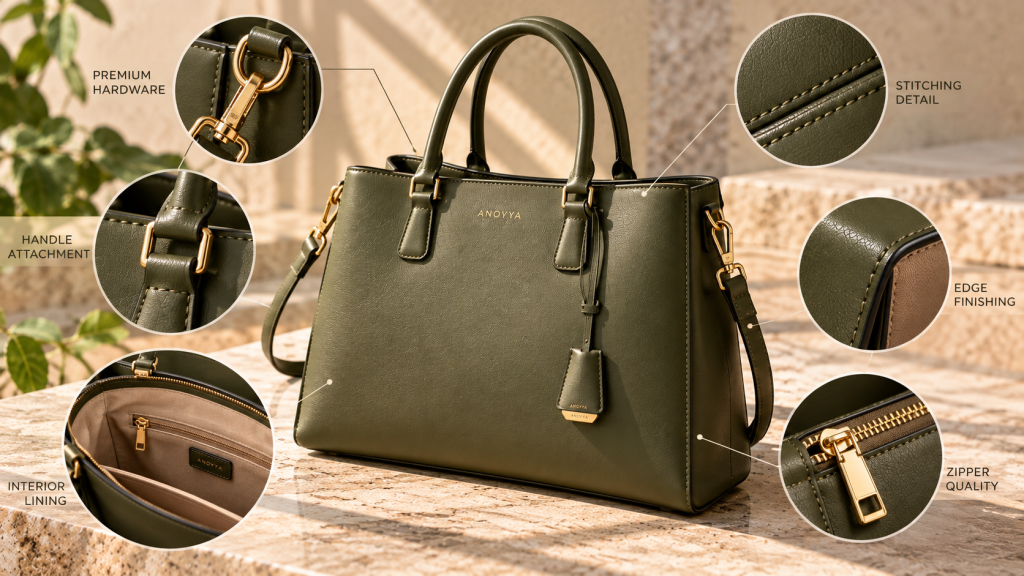
A premium-feeling handbag depends on details that you notice even when you cannot immediately identify them.
The first is surface feel.
A good material should feel intentional rather than excessively plastic, brittle or flimsy.
The second is construction.
Look at the points where the bag carries load:
- handle attachments
- strap anchors
- corners
- base
- zipper ends
- folds
- seams
These areas tell you more about construction quality than the centre of an untouched panel.
The third is edge finishing.
Clean edges help a handbag look precise. Poorly finished edges can make an otherwise attractive material look inexpensive.
The fourth is hardware.
Zippers, clasps, rings and other metal components should feel proportionate to the bag. Hardware that is too light, poorly fitted or visually mismatched can change the entire impression.
Modern vegan-leather handbag development similarly treats the outer material, reinforcement, lining, edge paint, stitching and hardware as one construction system.
Does Vegan Leather Work Better for Some Handbag Styles?
Yes. Different handbag silhouettes place different demands on the material.
A structured tote generally needs more body and panel definition.
A slouchy shoulder bag benefits from controlled flexibility.
A compact wallet needs clean folding and edge behaviour.
A card holder needs precise construction because the material is used at much smaller dimensions.
This is why asking “Is vegan leather good?” is less useful than asking:
“Is this particular vegan leather suitable for this particular bag?”
That distinction is important.
A material can perform beautifully in one construction and be unsuitable for another.
The same principle applies to cactus leather and other plant-based alternatives.
What Should You Look For When Buying a Vegan Leather Handbag?
Look beyond the word “vegan” and examine the entire handbag.
1. Look at the surface
Check whether the texture looks consistent across panels.
2. Feel the material
Flex a discreet area and notice whether it feels excessively stiff, thin or brittle.
3. Inspect the edges
Edges should look clean and consistently finished.
4. Check the handles
The attachment points should look reinforced rather than simply stitched onto a flat panel.
5. Examine the hardware
Zippers, clasps and rings should feel properly integrated with the design.
6. Look inside
The lining, pockets and internal structure are part of the handbag’s quality.
7. Ask what the material actually is
“Vegan leather” is a category, not a precise material specification. It can describe different constructions and compositions, so material transparency matters.
For a deeper buying framework, see our guide on how to choose a vegan leather handbag that actually lasts.
Is Vegan Leather Only About Sustainability?
No. The strongest handbag designs treat sustainability as one part of the product rather than the entire selling point.
A handbag still needs to be attractive.
It still needs to feel good.
It still needs to function.
It still needs to hold its shape and survive normal use.
ANOVYA’s sustainability philosophy specifically combines plant-based cactus leather with longevity, craftsmanship, small-batch production and timeless design rather than treating material choice as the only sustainability consideration.
That is a useful distinction for consumers.
A sustainable material does not automatically make a well-designed handbag.
The product has to earn its place in your wardrobe first.
Where Vegan Leather Still Has Limitations
Vegan leather should not be presented as a universal replacement for every leather application.
Different vegan materials vary significantly in composition, surface performance, backing and durability. Some may use polymer coatings or binders alongside plant-derived components, while others are conventional synthetic materials.
That is why blanket statements such as “all vegan leather lasts the same” or “all plant-based leather is biodegradable” are misleading.
For the buyer, the practical rule is simple:
Judge the specific material and the finished handbag, not the category name alone.
This also makes the conversation around cactus leather more credible. The material can be interesting precisely because it introduces another option, not because it eliminates every trade-off.
The Future of Vegan Leather Handbag Design
The future of the vegan leather handbag is likely to be less about copying traditional leather and more about developing a distinct design language around new materials.
That means:
- softer structured silhouettes
- richer surface textures
- more deliberate colour development
- cleaner hardware integration
- better material transparency
- plant-based material innovation
- stronger attention to construction
Recent handbag-material research is already pointing toward softer structures, richer textures and more tactile surfaces as important directions for upcoming collections.
For consumers, this is good news because the choice is becoming less binary.
You are no longer simply choosing between “traditional leather” and “faux leather.”
You can look at what the material is, how it feels, how the handbag is constructed and what kind of design it enables.
Final Takeaway
Vegan leather handbag design is evolving from simple material substitution into a more deliberate design conversation. Texture, structure, flexibility, colour, hardware and construction all influence what the finished bag becomes.
Cactus-based materials add another dimension to that conversation, particularly for brands exploring plant-based fashion accessories.
The best approach is not to choose a handbag because it says “vegan leather” on the label. Look at the material, construction and design together. When those three work in harmony, vegan leather can be much more than an alternative material—it can become part of the handbag’s identity.
Explore ANOVYA’s cactus leather handbags and accessories to see how plant-based material can be translated into contemporary fashion design. For the material story itself, you can also read why cactus leather is different and the philosophy behind ANOVYA’s design approach.
FAQ
Is vegan leather good for handbags?
Yes, vegan leather can be well suited to handbags, but quality varies by material and construction. The specific surface, backing, flexibility, reinforcement and finishing determine how a bag behaves. A well-made vegan handbag should be evaluated as a complete product rather than judged only by the material label.
Does vegan leather make handbags look cheap?
Not necessarily. A vegan leather handbag can have a refined appearance when the surface, silhouette, stitching, edge finishing, hardware and proportions are well executed. The material category alone does not determine whether a handbag looks premium. Construction quality and design have a major influence on the final result.
What makes a vegan leather handbag look luxurious?
A luxurious vegan leather handbag usually combines a refined surface with clean proportions, precise stitching, controlled edges, good hardware and thoughtful internal construction. Texture also matters. Smooth, fine-grain and subtle finishes can create very different visual effects, so the material should be selected according to the intended design.
Is cactus leather good for handbags?
Cactus-based leather materials can be developed for fashion and handbag applications, but performance depends on the specific formulation and construction. Some cactus materials are engineered as flexible sheets that can be cut and sewn into handbags and accessories. Buyers should still evaluate the finished product rather than assuming every cactus material performs identically.
Is vegan leather the same as cactus leather?
No. Vegan leather is a broad category covering non-animal leather-like materials with different compositions. Cactus leather is one type of plant-based material within that wider category. Its exact composition, backing, coating and performance depend on the particular manufacturer and material formulation.
How can I tell if a vegan leather handbag is well made?
Check the surface, edges, stitching, handles, hardware, lining and internal construction. Pay particular attention to load-bearing points such as handle attachments and strap anchors. Also ask what material has actually been used. A transparent material description is more useful than simply seeing the words “vegan leather.”