
Cactus Leather Durability: How Well Does It Really Hold Up?
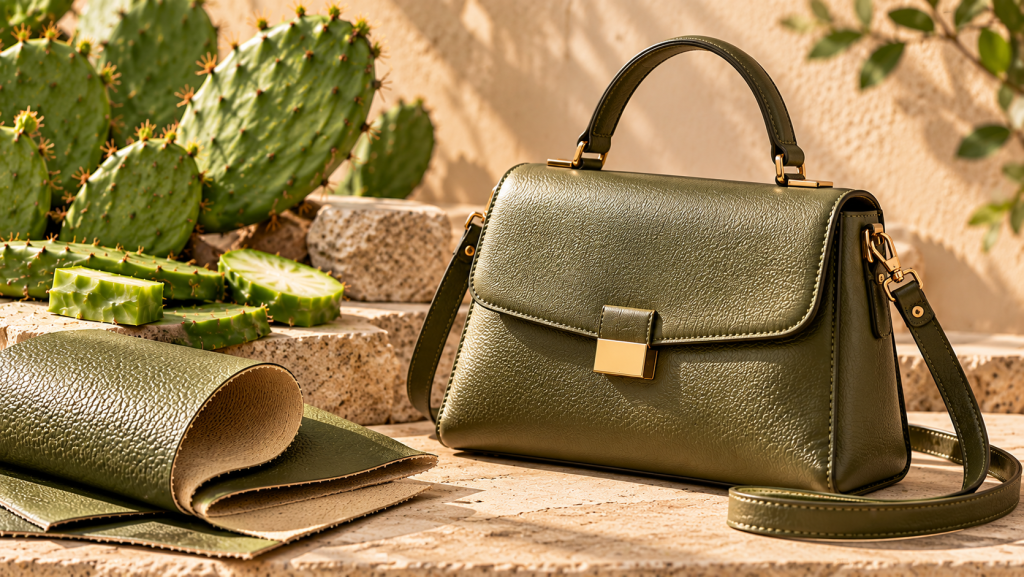
A cactus leather handbag can look excellent when it is new. The harder question is what happens after months of being carried, folded, rubbed against clothing, placed on surfaces and exposed to everyday conditions.
The honest answer is that cactus leather durability depends on the specific material formulation and the way the finished bag is constructed. There is promising real-world evidence, but the material is still relatively new compared with conventional leather, so decades of comparable use data do not yet exist.
Quick answer: Cactus leather can be durable enough for everyday handbags, but there is no universal lifespan for every cactus leather material. Wear depends on the formulation, thickness, backing, surface finish, stitching, hardware and how the bag is used. High-contact areas such as corners and straps are likely to show wear before large protected panels.
Is Cactus Leather Durable Enough for Everyday Use?
Yes, some cactus leather materials can withstand regular handbag use, but durability should be judged from the complete material and construction rather than the word “cactus” alone.
Commercial cactus-leather suppliers have reported resistance to abrasion, rubbing and tearing for specific formulations. PXG, for example, describes its Desserto® cactus leather as having resistance to abrasion, rubbing and tearing. That is a claim about that specific material, not a universal specification for every cactus leather product.
There is also some useful real-world evidence.
One independent one-year review of an Everlane bag made with Desserto® cactus leather found that the bag remained in good overall condition after heavy use. The reviewer observed more noticeable wear on the bottom corners and strap, while the seams, hardware and larger uninterrupted panels remained in good condition.
That is more useful than simply saying “cactus leather is durable.”
It shows where wear can actually appear.
The important caveat is that one bag over one year is not a laboratory durability test. It is an individual use experience.
So the sensible conclusion is:
Cactus leather has demonstrated practical durability for some handbag applications, but performance remains material- and construction-specific.
What Makes Cactus Leather Durable or Weak?
The durability of cactus leather depends on the entire material system, including its formulation, backing, thickness, surface finish and the construction of the finished product.
This is where many online comparisons become too simplistic.
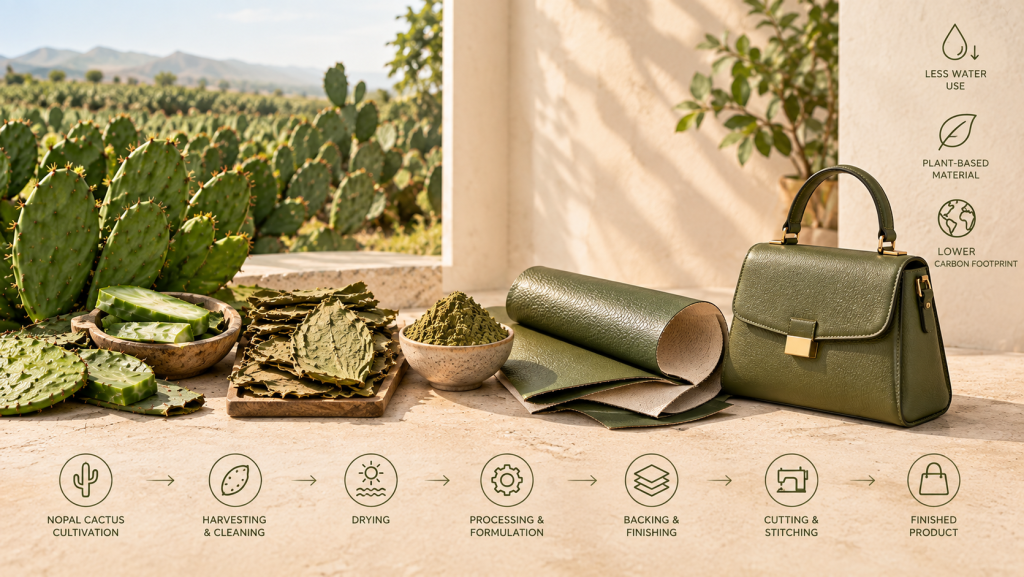
A material described as cactus leather is not simply dried cactus. As covered in [How Is Cactus Leather Made? From Nopal Cactus to Handbag], processed cactus material is incorporated into an engineered material system that can include backing and other formulation components.
Those components matter.
Material formulation
The formulation affects flexibility, surface behaviour and resistance to repeated movement.
Two materials can both be described as cactus leather while behaving differently because their formulations are different.
Thickness
A thin flexible material may behave differently from a thicker structured sheet.
Thicker does not automatically mean better. A handbag needs a balance between flexibility and structural support.
Backing
The backing supports the visible surface and can influence how the material behaves when folded, stitched and pulled.
Surface finish
The surface coating and finish affect how the material responds to friction, moisture and everyday marks.
Product construction
Even an excellent material can fail if the bag has poorly reinforced handles, weak seams or badly supported hardware.
In practice, a handbag is only as durable as its weakest high-stress component.
Where Does Cactus Leather Show Wear First?
High-contact areas such as corners, straps, folds and edges are likely to show wear before large, protected panels.
This is one of the clearest lessons from actual use.
In the one-year Everlane cactus leather review, the most noticeable wear appeared around the bottom corners and strap, while the larger material panels remained relatively clean. The corners also developed darker areas, and creasing in the strap became more pronounced.
That makes sense from a product-engineering perspective.
Think about what happens to a handbag during a normal day.
The bottom may touch a table or chair.
The corners may rub against surfaces.
The strap bends repeatedly.
The handle gets gripped.
The zipper area is opened and closed.
The main front panel, meanwhile, may experience much less direct friction.
So when evaluating a cactus leather bag, do not only inspect the centre of the front panel.
Look closely at:
- Bottom corners
- Handle attachment points
- Strap folds
- Seam edges
- Zipper areas
- Fold lines
- Hardware attachment points
- Base construction
These areas tell you much more about practical durability.
Does Cactus Leather Crack or Peel?
Cactus leather can develop surface wear, creasing or damage depending on its formulation and use, but there is no evidence-based universal rule that every cactus leather material will crack or peel after a fixed period.
This is where you should ignore simplistic claims.
Some PU-based leather alternatives are known for surface deterioration such as cracking or peeling as the material ages, but cactus leather is not one standardized formulation.
Its behaviour depends on what is actually in the finished material.
A cactus-based material with a particular backing and surface system can behave differently from another product using a different formulation.
The one-year independent review mentioned earlier did not report severe surface failure on the main panels of the tested bag. It did report increased creasing on the strap and some darkening around the corners.
That is a useful distinction.
Wear is not automatically the same thing as material failure.
A crease, slight colour change or corner mark can be cosmetic wear.
Peeling, delamination, tearing or loss of structural integrity is a different level of failure.
How Does Cactus Leather Handle Scratches and Scuffs?
Some cactus leather materials can resist ordinary scuffs reasonably well, but resistance to scratches depends on the particular surface finish and the force involved.
The one-year Everlane review is encouraging on this point: the reviewer reported that the main cactus leather surface resisted most scuffs and scratches during regular use.
But this should not be interpreted as “scratch-proof.”
No handbag material should be treated that way.
Keys, rough walls, metal furniture, abrasive surfaces and sharp objects can damage almost any finished handbag material.
There is also a practical difference between:
surface marking
and
surface damage.
A light mark may be removable or barely noticeable.
A deep scratch that breaks through the surface finish is much more serious.
This is why daily handling still matters even when the material has good abrasion resistance.
Does Heat, Humidity and Sunlight Affect Cactus Leather?

Yes, environmental exposure matters, so cactus leather handbags should be protected from prolonged direct sunlight, excessive heat and unsuitable storage conditions.
Care guidance from PXG recommends storing cactus leather handbags in a cool, dry place away from direct sunlight and using a dust bag with stuffing to help retain their shape.
This is particularly relevant in India.
A handbag left inside a hot car, beside a sunny window or against a high-heat surface is experiencing conditions that are different from normal indoor storage.
Delhi summer makes this even more relevant.
You do not need to treat the bag like laboratory equipment. But basic storage discipline makes sense:
- Avoid prolonged direct sunlight.
- Do not leave the bag inside a hot vehicle for extended periods.
- Store it in a cool, dry environment.
- Use a dust bag when it is not being used.
- Avoid storing it compressed under heavy objects.
- Maintain the bag’s shape with suitable stuffing during longer storage.
Care guidance for cactus leather products also commonly recommends gentle cleaning rather than aggressive chemical treatment. PXG specifically recommends wiping the material with a dry cotton cloth for everyday cleaning.
Cactus Leather Durability vs PU Leather
Cactus leather and PU leather can both work for handbags, but the comparison depends on the exact formulations rather than the material names alone.
| Factor | Cactus Leather | PU Leather |
|---|---|---|
| Main material story | Uses cactus-derived material within an engineered material system | Polymer-based leather alternative |
| Vegan | Yes | Yes |
| Plant-derived content | Present in cactus-based formulations, but exact composition varies | Not inherently plant-derived |
| Surface finish | Can be smooth, textured or embossed | Can be smooth, textured or embossed |
| Hand-feel | Can be soft and leather-like | Ranges from soft to noticeably synthetic |
| Durability | Depends on formulation and construction | Depends heavily on formulation and construction |
| High-contact wear | Corners, straps and folds deserve attention | Surface wear depends on formulation and finish |
| Environmental assessment | Requires looking at cactus content, backing, binders and end-of-life | Requires looking at polymer content, backing, production and end-of-life |
| Care | Follow the specific manufacturer’s instructions | Follow the specific manufacturer’s instructions |
The biggest mistake is treating “cactus” and “PU” as two completely standardized materials.
They are not.
A high-quality engineered material and a poorly constructed handbag can still make a disappointing combination.
The same is true in reverse.
A well-designed bag with good reinforcement can perform considerably better than its material label alone would suggest.
What Actually Makes a Cactus Leather Bag Last?
Good construction, sensible daily use and proper care can matter just as much as the cactus leather itself.
Look at the bag as a complete product.
1. Handle reinforcement
Handles experience repeated pulling and bending.
The attachment needs to distribute that load rather than concentrating it into one small area.
2. Strap construction
A strap is constantly flexing.
Creasing is therefore more likely here than on a flat front panel.
3. Corner protection
Corners often make first contact with tables, floors and other surfaces.
A well-designed base can reduce unnecessary abrasion.
4. Stitching
Consistent stitching and appropriate reinforcement help prevent seams from becoming the weak point.
5. Hardware
Zippers, rings, clasps and handle fittings are repeatedly operated.
Good material paired with weak hardware is still a weak handbag.
6. Lining and internal structure
The inside construction affects how the bag holds its shape and how much stress reaches the outer material.
7. Storage
A bag that is folded, compressed or stored in direct sunlight can age differently from one kept in suitable conditions.
The practical lesson is simple:
Do not judge durability from the outer material alone.
Can You Make Cactus Leather Last Longer?
Yes, sensible care can reduce avoidable wear and help preserve the material and construction.
The first rule is to follow the care instructions supplied for the specific material.
For everyday cleaning, a dry soft cloth is a common recommendation for cactus leather products. PXG also recommends keeping the bag away from direct sunlight and storing it in a cool, dry place.
Avoid experimenting with strong cleaning chemicals.
Do not use a rough brush simply because a mark is difficult to remove.
Do not deliberately expose the material to heat to “test” its resistance.
And do not overfill the bag to the point where panels, seams and handles are under unnecessary tension.
These sound like small details.
Over months of use, they add up.
What Can We Actually Say About Cactus Leather’s Long-Term Durability?
The fairest conclusion is that cactus leather shows promising everyday performance, but it is too early to make universal claims about multi-decade durability.
This is where honesty matters.
Desserto® was commercially introduced relatively recently compared with traditional leather, and even detailed independent reviews acknowledge that longer-term performance remains difficult to establish. The one-year Everlane review specifically notes that it cannot yet establish whether the material will remain strong over decades.
That does not mean cactus leather is fragile.
It means the evidence should be described accurately.
We have:
- Manufacturer testing and performance claims for specific formulations.
- Real-world use reports.
- Experience from products already on the market.
- Growing knowledge about material construction.
We do not yet have the same depth of multi-decade consumer history available for traditional leather.
That distinction makes the sustainability and durability discussion more credible.
Cactus Leather Durability: What Should You Check Before Buying?
Before buying a cactus leather handbag, inspect the areas most likely to experience repeated stress rather than judging the material only from its appearance.
Use this checklist:
| What to inspect | What to look for |
|---|---|
| Main panel | Even surface and consistent finish |
| Corners | Clean construction and reinforcement |
| Handles | Secure attachment with no obvious weak points |
| Strap | Flexible construction without excessive stiffness |
| Stitching | Even stitches and properly finished seams |
| Hardware | Secure attachment and smooth operation |
| Edges | Clean finishing without obvious separation |
| Lining | Properly fitted interior without excessive pulling |
| Material information | Clear explanation of the specific cactus-based material |
| Care instructions | Practical instructions for cleaning and storage |
This approach tells you much more than simply asking whether cactus leather is “durable.”
The better question is:
Is this particular cactus leather material, used in this particular bag, constructed well enough for the way I intend to use it?
Frequently Asked Questions
Is cactus leather durable enough for everyday handbags?
Yes, some cactus leather materials have demonstrated good performance in everyday handbag use. A one-year independent review of an Everlane bag using Desserto® reported that its main panels, seams and hardware remained in good condition, although the corners and strap showed more noticeable wear.
Does cactus leather scratch easily?
Not necessarily. One real-world one-year review reported that the tested cactus leather resisted most ordinary scuffs and scratches on its main surface. However, this does not mean every cactus leather material is scratch-proof. Surface formulation, finish, object contact and handling all affect scratch resistance.
Does cactus leather peel like PU leather?
There is no universal answer because cactus leather is not one standardized formulation. Some materials may use polymer coatings or binders, while others use different systems. Whether a particular product cracks, peels or delaminates depends on its formulation, construction, ageing and use. Avoid assuming that every cactus leather behaves identically.
Can cactus leather handle Indian heat?
Cactus leather handbags should be protected from prolonged direct sunlight and excessive heat regardless of climate. Care guidance from PXG recommends cool, dry storage away from direct sunlight. In hot Indian conditions, avoid leaving the bag for extended periods inside a hot vehicle or beside a strong source of heat.
How long can cactus leather last?
There is no scientifically established universal lifespan for every cactus leather product. Performance depends on the formulation, backing, finish, construction and use. Existing real-world evidence includes a one-year review showing good overall performance, but longer-term durability across different cactus materials and products still needs more time and data.
Is cactus leather more durable than ordinary vegan leather?
You cannot make that claim for every product because “vegan leather” includes many different materials and formulations. Some cactus-based materials are designed for strong abrasion and tear resistance, but the actual performance depends on the specific material and finished product. Compare the construction and technical information rather than relying only on the material category.
What part of a cactus leather handbag wears out first?
High-contact areas such as corners, straps, folds and edges are likely to show wear before large protected panels. A real-world one-year review observed the most noticeable wear on the bottom corners and strap, while the larger panels, seams and hardware remained in good condition.
Final Takeaway
Cactus leather durability is promising, but the material should be judged by evidence and construction rather than marketing claims.
A well-made cactus leather handbag can handle everyday use, and real-world experience shows that some materials can resist ordinary scuffs and retain their structure after substantial use. At the same time, corners, straps and other high-contact areas will naturally experience more wear.
There is also an important limitation: cactus leather is still a relatively new material category. We do not yet have the same decades-long body of use history available for conventional leather.
So the sensible approach is not to ask whether “cactus leather is durable” as though there is one universal answer.
Ask instead:
What is the exact material? How is it constructed? Where will it experience stress? How should it be cared for? And is the finished handbag engineered properly?
That gives you a much more realistic picture of durability.
If you are still learning about the material itself, start with [How Is Cactus Leather Made? From Nopal Cactus to Handbag]. For choosing a finished bag, read [How to Choose a Vegan Leather Handbag That Actually Lasts]. And for everyday maintenance, see [Cactus Leather Care: How to Clean and Store Your Bag].
At ANOVYA, the goal is not simply to use an interesting material. The material, construction, hardware, finishing and everyday usability all have to work together.