
Vegan Leather vs Plant-Based Leather: The Difference
What’s Actually the Difference?
Walk into any fashion store and you will see the words vegan leather everywhere.
But what does that actually mean?
Is vegan leather made from plants? Is it plastic? Is cactus leather the same thing? And if a handbag is labelled vegan, does that automatically mean it is sustainable?
Not necessarily.
The difference between vegan leather and plant-based leather is small in wording, but important in understanding what you are actually buying.
Vegan Leather vs Plant-Based Leather: The Short Answer
Vegan leather means a leather alternative made without animal-derived leather. Plant-based leather refers to materials that use plant-derived inputs as part of their material composition. The two terms can overlap, but they are not automatically interchangeable. Some vegan leathers are primarily synthetic, while some alternatives incorporate plant-derived materials.
That distinction matters because the word vegan tells you what the material does not contain, while plant-based tells you something about where part of the material comes from.
And once you understand that, shopping for a handbag becomes much easier.
What Does Vegan Leather Actually Mean?
Vegan leather is a broad category of leather alternatives that do not use conventional animal hide.
The word “vegan” describes the absence of animal-derived material. It does not, by itself, tell you whether the alternative is made from cactus, eucalyptus-derived material, polyurethane, PVC, or another formulation.
That is the first thing worth remembering.
For example, conventional leather is made from animal hide or skin. Textile Exchange defines leather specifically as animal hide or skin that has been tanned to make it durable and resistant to decay. Alternatives to leather can instead be synthetic or bio-based materials designed to perform a similar function.
So when you see:
“Vegan leather handbag”
you know that the handbag is being presented as an animal-free alternative.
But you still have another question to ask:
“What is it actually made from?”
That is where plant-based materials enter the conversation.
What Is Plant-Based Leather?
Plant-based leather refers to leather-like materials that use plant-derived inputs as part of their material story.
Cactus is one example.
Other material developers are exploring plant-derived cellulose, agricultural by-products, fibres and other biological inputs to create alternatives to conventional leather. The wider next-generation materials sector also includes materials derived from plants, algae, fungi, microbes and other sources.
But there is an important detail here.
Plant-based does not automatically mean 100% plant-derived.
A material can contain a plant-derived component while also using other materials, depending on the technology and formulation.
This is why the material’s complete composition matters more than a single attractive word on the label.
Vegan Leather Is a Category. Plant-Based Leather Is a Material Direction.
The easiest way to understand the difference is to think of “vegan leather” as the wider category and “plant-based leather” as one direction within that category.
Think of it like this:
| Term | What it tells you |
|---|---|
| Vegan leather | The material is presented as an alternative to animal-derived leather and does not use conventional animal leather |
| Synthetic vegan leather | A vegan leather alternative primarily made using synthetic materials |
| Plant-based leather | A leather-like material using plant-derived inputs |
| Cactus leather | A plant-based material associated with cactus as a feedstock |
| Eucalyptus-based material | A material approach that can use eucalyptus-derived inputs such as cellulose |
The important point is that “vegan” and “plant-based” answer different questions.
One is mainly about animal origin.
The other is about material origin.
And sometimes, they meet in the same product.
Is Vegan Leather Always Plant-Based?
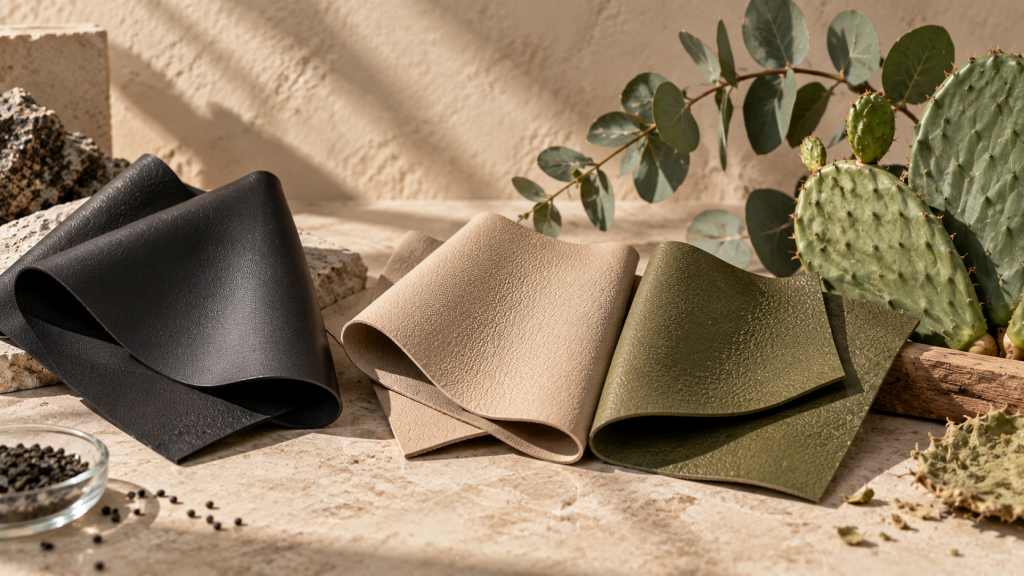
No. A vegan leather product can be completely free from animal leather without being primarily plant-based.
This is probably the most important distinction in this entire article.
Some vegan leather alternatives use synthetic polymers such as polyurethane or PVC. Textile Exchange categorizes these as alternatives to animal leather, while also separately recognizing synthetic and biobased alternatives.
So:
Vegan does not automatically mean plant-based.
And:
Vegan does not automatically mean sustainable.
These are three different ideas that are often mixed together:
Animal-free.
Plant-based.
Environmentally preferable.
They can overlap, but they are not synonyms.
That is why a responsible material conversation needs to go deeper than the front of the product tag.
Is Plant-Based Leather Automatically Sustainable?
No. The plant origin of a material is important, but it is only one part of the sustainability picture.
This is where we believe the conversation becomes much more interesting.
A material can start with a plant and still involve other inputs, processing stages, coatings, binders, energy use, transportation and end-of-life challenges.
The Material Innovation Initiative notes that many newer material alternatives still contain petroleum-derived plastics, while developers continue working to reduce dependence on petrochemical inputs.
So instead of asking:
“Is this plant-based?”
a better question is:
“What is this material actually made of, and how is it made?”
Then ask:
“How long is the finished product designed to last?”
Because sustainability does not end when the material leaves the factory.
So, Where Does Cactus Leather Fit In?
Cactus leather sits within the broader conversation around plant-based and vegan leather alternatives.
Cactus became the starting point for ANOVYA because it represented something more interesting than simply replacing one material with another.
It showed that a plant could become part of a premium fashion story.
Our current collection is built around cactus-based vegan leather, and the brand describes its cactus material as plant-based and PVC-free.
But the bigger idea goes beyond cactus.
As we explored in our previous article, cactus was the beginning, not the entire destination.
Material innovation is moving quickly, and different plants and biological resources are being investigated for different applications.
That is why our interest is not limited to one material forever.
Cactus, Eucalyptus and the Bigger Plant-Based Picture
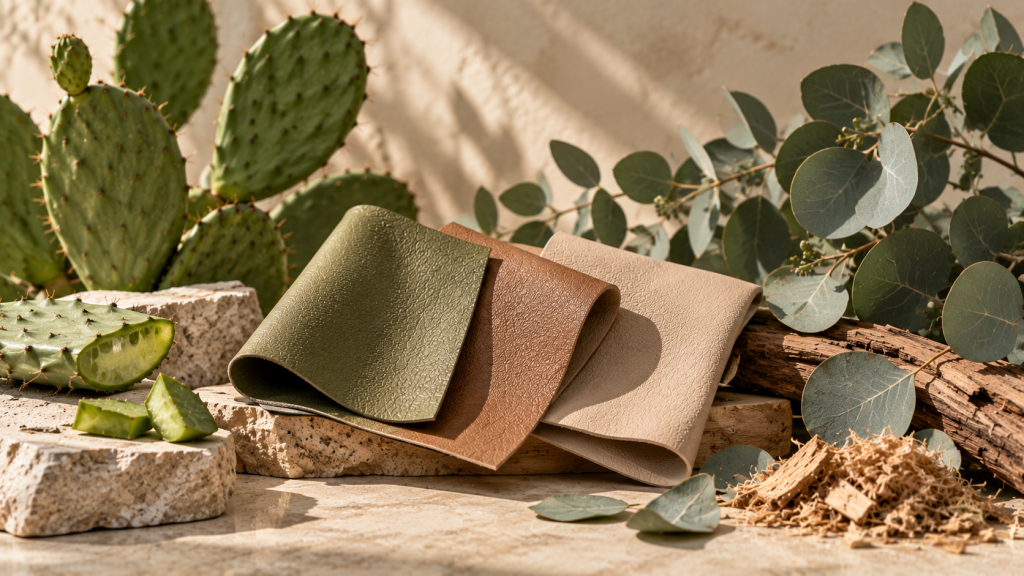
Cactus and eucalyptus represent two different material directions within a much larger plant-based materials conversation.
Cactus has already become part of ANOVYA’s product story.
Eucalyptus represents a material direction we are exploring for the future.
The important thing is not to treat every plant-based material as identical.
They are not.
Different technologies can produce different textures, structures, compositions and performance characteristics.
That means the future of plant-based fashion probably won’t be about finding one magical plant that replaces everything.
It will be about finding the right material for the right application.
A handbag, shoe, wallet and automotive interior do not necessarily need exactly the same material characteristics.
That is where material innovation becomes more than a sustainability trend.
It becomes a design problem.
What Should You Look For When Buying Vegan Leather?
Don’t stop at the words “vegan leather”; look for information about the actual material.
Here are five questions worth asking before buying:
1. What is the material actually made from?
Look for the specific material rather than relying only on “vegan.”
Cactus, PU, PVC, cellulose and other terms tell you more about the construction.
2. Is it plant-based?
If the product claims to be plant-based, check whether the brand explains which plant or biological input is involved.
Specificity builds trust.
3. Does it contain synthetic components?
Plant-derived inputs and synthetic components can exist together in some material technologies.
That is why “plant-based” should not automatically be interpreted as “plastic-free.”
4. How is the product made?
Material is only one part of the finished product.
Stitching, lining, hardware, adhesives, finishing and manufacturing all contribute to what you eventually carry.
5. How long is the product designed to last?
This question is often ignored.
But a handbag designed to be used for years tells a different story from a product designed around short-term trends.
Vegan, Plant-Based and Sustainable: Three Different Questions
The easiest way to avoid confusion is to separate the three terms.
Vegan asks:
Does it contain animal-derived leather?
Plant-based asks:
Does the material use plant-derived inputs?
Sustainable asks:
What is the overall environmental and social impact of the material and product?
The third question is the hardest because it requires looking at the entire system.
That is also why ANOVYA approaches sustainability as an ongoing process rather than a single claim. The brand’s sustainability philosophy combines plant-based materials with small-batch production, responsible packaging, craftsmanship and product longevity.
A material label is the beginning of the conversation, not the end.
Why This Difference Matters for Luxury Fashion
Luxury is ultimately about more than the material name; it is about how the material becomes a product.
A handbag can have an interesting material story and still fail as a luxury product if the construction feels disposable.
The opposite is also true.
When material innovation meets thoughtful design, finishing and longevity, the result can feel completely different.
That is the direction we believe conscious luxury should take.
Not:
“Buy this because it is vegan.”
But:
“Understand what it is made from. Look at how it is made. Then decide whether the product deserves a place in your life.”
That is a much more meaningful relationship with fashion.
The Future Is Not Just Vegan. It Is Material-Conscious.
The next generation of fashion will require consumers to become more curious about materials.
The industry is already moving beyond the simple choice between animal leather and synthetic alternatives. Material innovators are working on alternatives derived from plants, fungi, microbes and other sources, while also trying to improve performance, scale, cost and environmental impact.
For us, that creates an exciting possibility.
Cactus can be one chapter.
Eucalyptus can become another.
And the wider world of plant-based innovation can keep opening new doors.
The goal isn’t to pretend that one material has solved every problem.
The goal is to keep making better material choices.
What This Means for ANOVYA
ANOVYA began with a simple question: can luxury feel different when the material story changes?
Our answer started with cactus.
It continues with our exploration of new plant-based material possibilities.
But the philosophy stays the same:
Design should never feel like a compromise.
Sustainability should never be reduced to a label.
And responsible materials should be desirable enough that people choose them because they love the product first.
That is the kind of future we want to build.
Not just vegan.
Not just plant-based.
Material-conscious.
FAQ: Vegan Leather & Plant-Based Leather
Is vegan leather the same as plant-based leather?
No. Vegan leather is a broader term for animal-free leather alternatives, while plant-based leather refers to materials using plant-derived inputs. A vegan material can be synthetic, plant-based, or a combination depending on its formulation.
Is all vegan leather made from plants?
No. Some vegan leather alternatives are made primarily from synthetic materials such as polyurethane or PVC. The word “vegan” tells you that conventional animal leather is not used; it does not identify the material’s complete composition.
Is plant-based leather 100% plant-based?
Not necessarily. Some plant-based leather technologies combine plant-derived inputs with other materials, including synthetic components. Always check the manufacturer’s material composition rather than assuming that “plant-based” means every component comes from plants.
Is cactus leather vegan?
Cactus-based leather alternatives can be vegan when their complete formulation contains no animal-derived materials. ANOVYA’s current material story is based on cactus-based vegan leather, with the brand describing its material as plant-based and PVC-free.
Is plant-based leather more sustainable than vegan leather?
The terms cannot be compared that simply. Vegan leather describes an animal-free category, while plant-based describes a material source. Environmental performance depends on the complete formulation, production process, durability, transportation and end-of-life considerations.
Why is ANOVYA exploring different plant-based materials?
Different materials can offer different possibilities for texture, construction, performance and design. ANOVYA began with cactus and is exploring further plant-based material directions, including eucalyptus, as part of a broader material-innovation journey.
CLOSING TAKEAWAY
Vegan tells you that animal leather isn’t being used.
Plant-based tells you that a plant-derived material is part of the story.
Sustainable asks a much bigger question about the entire product.
Understanding that difference is the first step toward becoming a more informed fashion consumer.