
From Cactus to Eucalyptus: The Next Chapter of Plant-Based Leather
From Cactus to Eucalyptus: The Next Chapter of Plant-Based Leather
Leather has always been associated with craftsmanship, luxury and longevity. But the material story behind fashion is changing.
In our previous article, we explored cactus leather — what it is, how plant-based leather works and why cactus has become such an interesting material for modern fashion.
Now, the conversation moves one step further.
Cactus was the beginning.
Eucalyptus is what comes next.
And behind both is a much bigger idea: the future of fashion may not be about finding one perfect alternative to leather. It may be about discovering better materials from the plant world, one innovation at a time.
THE NEXT CHAPTER DOESN’T START WITH A NEW BAG. IT STARTS WITH A NEW MATERIAL.
Fashion changes quickly. Materials usually don’t.
For decades, leather remained one of the most familiar materials for handbags, footwear and accessories. Synthetic alternatives later gave brands another option, but many of these materials are still heavily dependent on petroleum-derived plastics.
Plant-based material innovation is opening another path.
Instead of asking, “How can we make another version of synthetic leather?”, designers and material developers are increasingly asking a different question:
“What can nature give us?”
That shift is important.
Because when you change the material, you can change much more than the appearance of a product. You can change the story behind it, the resources involved in making it and the possibilities available to future designers.
CACTUS WAS THE BEGINNING
Our journey into plant-based materials began with cactus.
Cactus is fascinating because it challenges the traditional idea of what a premium fashion material has to come from.
Instead of an animal hide, cactus can become the starting point for a leather-like material designed for fashion applications.
That makes cactus more than simply a substitute.
It represents a different way of thinking about materials.
At ANOVYA, cactus leather became the foundation of our first material story — a material chosen not because it was a trend, but because it represented the kind of direction we wanted to explore: plant-based, design-led and capable of becoming part of a premium fashion product.
And that is where the story becomes more interesting.
Because if one plant can become the beginning of a new material conversation, what happens when we start looking beyond just one plant?
NOW, EUCALYPTUS ENTERS THE STORY
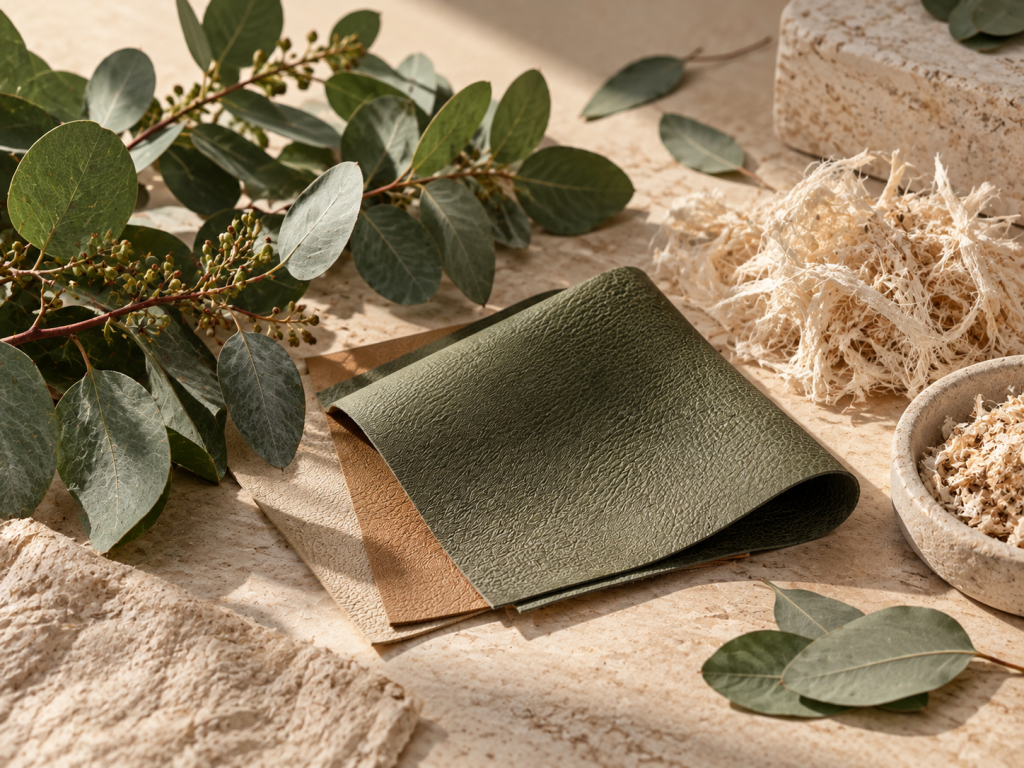
Eucalyptus is the next chapter we are exploring.
Eucalyptus-based leather alternatives are being developed using cellulose derived from plant sources. One example is Eori®, a bio-based material developed around cellulose and positioned for leather-like applications in fashion and other industries.
The important point is not that eucalyptus is simply “the new cactus.”
It isn’t.
Different plants can offer different material possibilities. The processing technology, formulation, backing, coatings, binders and finishing can all influence the final material.
That is exactly what makes material innovation exciting.
Eucalyptus gives us another possibility to explore.
For ANOVYA, it represents the direction we are moving towards: building a future where plant-based materials are not limited to one source.
Cactus is already part of our story.
Eucalyptus is coming next.
CACTUS AND EUCALYPTUS: TWO PLANTS, ONE DIRECTION
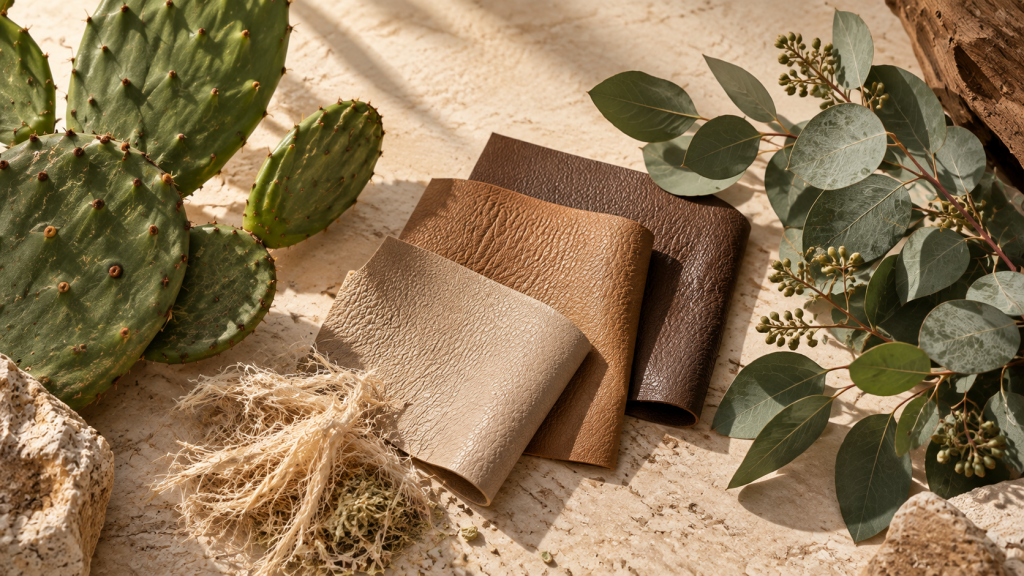
Cactus and eucalyptus may come from completely different plants, but they can sit within the same larger conversation about plant-based alternatives.
Here is the simplest way to understand the difference.
Cactus leather begins with cactus-based feedstock and is already part of our current material story.
Eucalyptus-based alternatives can use cellulose from eucalyptus as a starting point for developing leather-like materials.
Neither should be judged only by the name of the plant.
The real question is always:
How is the material made?
What else is used in the formulation?
How does it perform?
How long is the finished product designed to last?
And what happens at the end of its useful life?
This matters because “plant-based” does not automatically mean “perfect.”
A responsible material conversation has to look beyond the headline.
WHY PLANT-BASED DOESN’T MEAN ONE PLANT
The future of plant-based fashion is unlikely to belong to a single material.
Think about it.
Fashion does not use only one type of fabric.
It uses cotton, linen, silk, wool, recycled fibres and many engineered materials because different applications demand different characteristics.
The same logic applies to leather alternatives.
A handbag may require a certain combination of flexibility, surface finish, structure and durability.
A shoe may need something different.
An automotive interior may have completely different performance requirements.
That means the future isn’t necessarily about declaring one plant the winner.
It is about understanding which material works for which purpose.
Kya use karein is not just a question for the customer.
It is a question for designers and material innovators too.
THE MATERIAL IS ONLY HALF THE STORY
A beautiful material can still become an unsustainable product if the product itself is poorly designed.
That is why longevity matters.
A handbag that is used for years tells a very different sustainability story from a handbag that is discarded after a few months.
The same applies to hardware, stitching, construction, finishing and repairability.
Material innovation and product longevity have to move together.
This is why our approach is not simply about putting a “plant-based” label on a product.
The material needs to support a product that people actually want to keep.
The design needs to remain relevant beyond one season.
And the construction needs to justify the resources used to make it.
For us, sustainability becomes more meaningful when it meets craftsmanship.
WHY EUCALYPTUS IS INTERESTING FOR THE FUTURE OF FASHION
Eucalyptus brings an interesting material story because cellulose is one of the fundamental building blocks used in many plant-based material technologies.
Research and commercial material developers are already exploring eucalyptus-derived cellulose and eucalyptus-based by-products for textile and leather-like applications.
That does not mean every material described as “eucalyptus leather” has the same composition.
It doesn’t.
And this distinction matters.
Some materials may use eucalyptus-derived cellulose as a major component, while others may combine plant-derived inputs with additional fibres, binders or coatings.
So when you hear “eucalyptus leather”, don’t stop at the plant name.
Look deeper.
Ask what the material actually contains.
Ask how it is manufactured.
Ask what percentage is bio-based.
Ask whether plastic or synthetic components are involved.
Ask how the finished product is expected to perform.
That is how material innovation becomes a meaningful conversation rather than simply another marketing phrase.
THE FUTURE OF ANOVYA IS BIGGER THAN CACTUS
Cactus will always be an important part of our story because it was where this journey began.
But our ambition is broader.
We want to explore what happens when fashion begins to look at plants not simply as agricultural resources, but as sources of new material possibilities.
Today, cactus.
Next, eucalyptus.
And beyond that, the research and development landscape continues to evolve.
We are not claiming to have every answer.
We are interested in asking better questions.
Can a material feel luxurious without coming from an animal?
Can responsible materials become desirable rather than merely “eco-friendly”?
Can sustainability exist alongside craftsmanship, elegance and modern design?
And can an Indian fashion brand contribute to that conversation from the beginning?
Those are the questions that will shape the next chapter.
NOT JUST VEGAN. MATERIAL-CONSCIOUS.
There is an important distinction between being vegan and being material-conscious.
Vegan describes the absence of animal-derived materials.
Material consciousness goes further.
It asks where a material comes from.
How it is processed.
What it contains.
How long it can be used.
How the product is made.
And what happens when the product eventually reaches the end of its useful life.
That is a much bigger conversation.
And it is one the fashion industry will have to become increasingly comfortable having.
Because the future of responsible fashion will not be decided by a single word on a product label.
It will be decided by better questions and better material choices.
FROM ONE PLANT TO A WORLD OF POSSIBILITIES
The most exciting part of this journey is that it is still evolving.
Cactus showed us that a plant can become part of a luxury material story.
Eucalyptus opens another door.
And the wider world of plant-based material innovation continues to develop through research, experimentation and new manufacturing technologies.
We don’t know exactly what the material landscape will look like ten years from now.
But we know what direction we want to explore.
More responsible materials.
Better design.
Longer-lasting products.
And a fashion industry that sees nature not simply as something to consume, but as a source of inspiration for what comes next.
THE NEXT CHAPTER IS ALREADY GROWING
Cactus was the beginning.
Eucalyptus is the next step.
But the real story is bigger than either one.
It is about moving from a fashion industry that asks, “What has always been used?”
to one that asks,
“What else is possible?”
That is the future we want to explore.
Not by abandoning luxury.
Not by compromising design.
But by rethinking what luxury can be made from.
The next generation of fashion will not only be defined by how a product looks.
It will also be defined by the story of the material in your hands.
And that story is only beginning.