
Cactus Leather vs Traditional Leather: What Really Changes?
Traditional leather has spent generations defining what luxury feels like. Cactus leather is asking whether luxury can be built around a different material story.
But comparing the two is not as simple as asking which one is “better”.
They come from different sources, are manufactured differently and can behave differently over time. If you are considering a cactus leather handbag, the useful question is not simply, “Is cactus leather better than leather?”
It is: What actually changes when the material changes?
Quick answer: Cactus leather is a plant-derived alternative to animal leather, while traditional leather is made from animal hide. Cactus leather can offer a leather-like appearance and feel without animal-derived material, but its durability, composition and environmental profile depend on the specific formulation, backing and finishing process. Traditional leather has a much longer track record for durability and patina.
Cactus Leather vs Traditional Leather: What Is the Basic Difference?
The basic difference is where the material comes from and how the finished sheet is engineered.
Traditional leather begins with animal hide. The hide is processed and tanned, then finished for the intended application. Its natural grain, thickness and fibre structure contribute to the character and performance of the final material.
Cactus leather starts with cactus biomass, which is processed and combined with other material components to create a flexible sheet suitable for applications such as bags, footwear and accessories. It is therefore better understood as an engineered material inspired by leather, rather than simply a cactus leaf turned into a handbag.
That distinction matters.
A finished cactus-based material can contain several layers or components, including:
- Cactus-derived material
- A supporting textile or carrier
- A binder or resin system
- Surface coatings
- Pigments and finishing layers
The exact composition varies between manufacturers and material generations. Research on leather alternatives also shows that plant-based materials can differ significantly in their bio-based content and polymer systems.
So when comparing cactus leather vs traditional leather, you are not comparing a plant leaf directly with an animal hide. You are comparing two finished material systems with different origins and manufacturing approaches.
Is Cactus Leather Actually Plant-Based?
Yes, cactus leather can be plant-based, but “cactus leather” does not automatically mean that the finished material is 100% plant-derived.
This is one of the most important points to understand before buying a cactus leather product.
The cactus component can provide part of the material structure, but manufacturers may use binders, coatings, backing fabrics or other polymers to achieve flexibility, strength, surface consistency and durability.
A recent review of leather alternatives specifically notes that plant-based leather materials vary considerably in bio-based content and may use synthetic binders or coatings.
So there are three different statements:
“Made using cactus” — tells you the material contains cactus-derived input.
“Plant-based” — tells you a significant part of the material comes from biological/plant sources, depending on the manufacturer’s definition.
“100% plant-based” or “plastic-free” — is a much stronger claim and should only be made when the complete material composition supports it.
This is why material transparency matters more than a catchy label.
If you are buying a premium handbag, ask what the outer material is made from, what backing is used and whether the manufacturer discloses the composition.
Cactus Leather vs Traditional Leather: How Do They Feel?
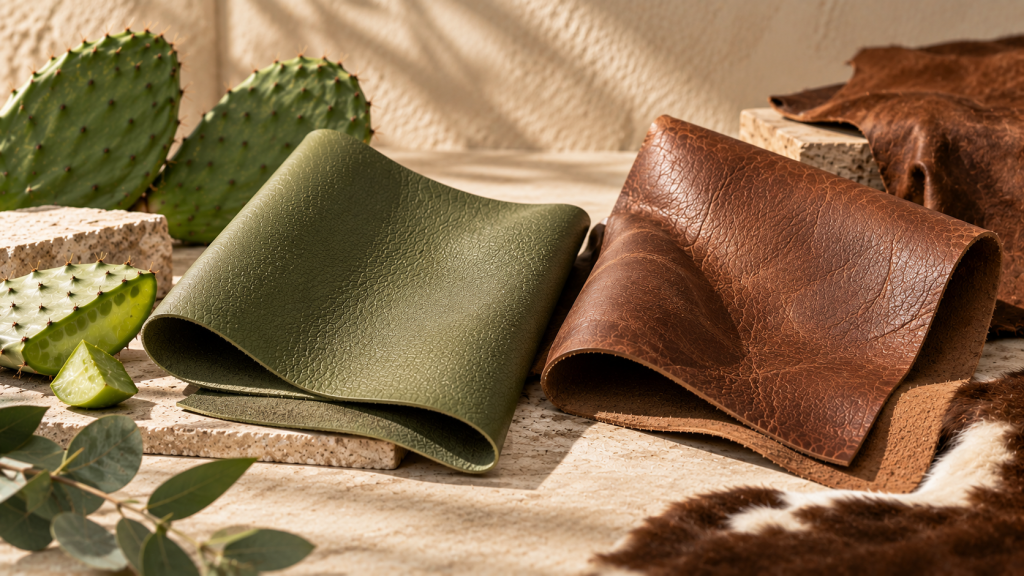
Both materials can be soft, smooth, textured or structured, but the final feel depends heavily on finishing and construction.
Traditional leather has a natural fibre structure that gives different hides their characteristic hand feel. Full-grain, top-grain and corrected leather can feel noticeably different even though they all belong to the traditional leather category.
Cactus-based materials can also be engineered with different surface textures and finishes.
A premium cactus material can be:
- Smooth and refined
- Lightly textured
- Embossed with a grain pattern
- Matte or slightly glossy
- Structured for handbags
- Softened for a more flexible construction
This means you should not judge cactus leather only by touching one sample.
The material formulation, thickness, backing, finishing and the way the handbag is constructed all influence the final experience.
For a handbag, the lining, reinforcement, stitching, edge finishing and hardware can matter almost as much as the outer material.
Which One Is More Durable?
Traditional leather has the stronger long-term track record, particularly high-quality leather that is properly constructed and maintained.
That does not mean every leather handbag is more durable than every cactus leather handbag.
A poorly constructed leather bag can fail at the stitching, zipper, lining or handle attachment. Likewise, a well-designed cactus leather handbag can perform very well under normal fashion use.
Durability depends on several variables:
| Factor | Cactus Leather | Traditional Leather |
|---|---|---|
| Material structure | Engineered layered/composite construction | Natural hide fibre structure |
| Surface durability | Depends on formulation and coating | Depends on hide quality and finishing |
| Stitching performance | Depends on material thickness and construction | Generally well established |
| Water/moisture response | Depends on finish and formulation | Depends on leather type and finish |
| Long-term track record | Newer material category | Decades of established use |
| Repairability | Depends on construction and material | Generally well established |
| Ageing | Material-specific | Often develops patina |
Research reviews continue to identify durability and consistency as important development areas for plant-based leather alternatives, while traditional leather remains well established for long-term performance.
For a handbag, this leads to a practical rule:
Do not buy only on the material name. Look at the complete construction.
A cactus leather bag with reinforced handles, good stitching, quality hardware and a properly selected lining can be a very different product from a low-cost bag using a thin alternative leather.
Does Cactus Leather Develop the Same Patina as Traditional Leather?
Not necessarily, and this is one area where traditional leather has a distinctive advantage.
High-quality traditional leather can change with age. Scratches, handling, conditioning and exposure can gradually create a patina that becomes part of the character of the product.
Cactus leather does not necessarily age in exactly the same way.
Depending on its formulation and surface finish, it may retain a more consistent appearance rather than developing the same natural patina associated with certain traditional leathers.
That is not automatically good or bad.
It comes down to what you want from the handbag.
If you enjoy seeing a material become visibly more individual with years of use, traditional leather offers an established ageing story.
If you prefer a cleaner and more consistent surface appearance while choosing a material without animal-derived leather, cactus-based material offers a different proposition.
Is Cactus Leather More Sustainable Than Traditional Leather?
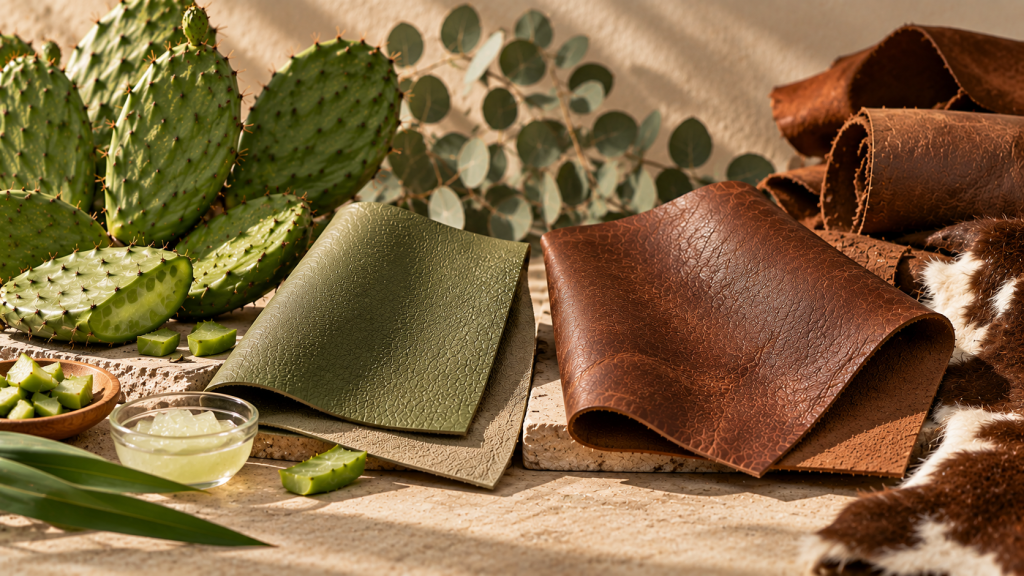
There is no responsible one-line answer because sustainability depends on the entire material system and its lifecycle.
Cactus leather can reduce reliance on animal-derived material, and research has identified potential environmental advantages for some cactus-based materials. However, the finished material can still contain polymer binders, coatings or synthetic backing layers.
Traditional leather also has a complex environmental profile. Its footprint involves livestock production, hide processing, tanning, finishing, transportation and the useful life of the finished product.
So the comparison should look beyond the raw material.
Consider:
- Where the raw material comes from
- How much processing is required
- What binders and coatings are used
- What backing material is used
- How long the finished product lasts
- Whether the product can be repaired
- What happens at the end of its useful life
A cactus label alone does not answer all seven questions.
Likewise, calling something “real leather” does not automatically make its environmental impact low.
The most useful approach is to look at the specific material and the complete product, rather than awarding a sustainability label based only on the word “cactus”.
Cactus Leather vs Traditional Leather for Handbags: Which Changes the Buying Decision?
For handbags, the biggest differences are usually material origin, ageing behaviour, construction requirements and the values behind the purchase.
| Buying factor | Cactus Leather | Traditional Leather |
|---|---|---|
| Animal-derived material | No | Yes |
| Material origin | Plant-derived input with additional material components depending on formulation | Animal hide |
| Luxury appearance | Can be designed with refined textures and finishes | Established luxury material with natural grain variation |
| Feel | Depends on formulation and finish | Depends strongly on hide type and tanning |
| Patina | Not necessarily the same as traditional leather | Often develops with use |
| Durability | Highly formulation- and construction-dependent | Strong established track record |
| Material consistency | Can offer controlled surface consistency | Natural variation is part of the material |
| Sustainability story | Can reduce reliance on animal-derived material; full profile depends on formulation | Complex profile involving livestock, tanning and longevity |
| Repair | Depends on construction and material | Established repair ecosystem |
| Vegan requirement | Suitable for vegan product design when the complete product is animal-free | Not vegan |
For a premium handbag, there is another factor buyers sometimes overlook: design can compensate for some material differences, but it cannot compensate for poor material selection.
Handle attachment, seam placement, reinforcement, edge finishing and hardware quality all affect how a bag performs.
What Should You Check Before Buying a Cactus Leather Bag?
Before buying a cactus leather handbag, check the material composition, construction quality and care requirements rather than relying only on the sustainability claim.
Here is a practical buyer checklist.
1. Ask what the material actually contains.
Find out whether the material uses cactus biomass, a bio-based polymer, PU, textile backing or other components.
2. Check the thickness and construction.
A handbag requires different material performance around the body, handles, corners and closure areas.
3. Look closely at the stitching.
Even an excellent material can fail if the thread tension, stitch density or reinforcement is poor.
4. Inspect the handle attachment.
Handles experience repeated pulling forces. The attachment method matters more than a material name printed on the product page.
5. Ask about care.
Do not assume that cactus leather should be maintained exactly like traditional leather.
6. Check the finish.
A coated surface can behave differently from an uncoated or differently finished material.
7. Look for transparency.
A responsible material description should explain what the manufacturer is actually selling rather than simply saying “eco-friendly leather”.
Cactus Leather or Traditional Leather: Kab Kya Use Karein?
The right material depends on what you want the product to do.
Choose traditional leather when natural hide character, established long-term durability, patina and a mature repair ecosystem are central to your expectations.
Choose cactus leather when you want a handbag without animal-derived leather and are interested in plant-derived material innovation, while accepting that performance depends on the exact formulation and construction.
For someone buying a handbag for everyday use, the decision should therefore be based on more than sustainability.
Look at:
Material + construction + intended use + maintenance + longevity.
That combination tells you far more than the word “leather”.
What About Price?
Cactus leather handbags do not automatically have to be cheaper than traditional leather handbags.
The price of a finished handbag depends on far more than the cost of the outer material.
A premium bag may include:
- Material cost
- Pattern development
- Cutting and wastage
- Stitching
- Lining
- Reinforcement
- Zippers
- Metal hardware
- Edge finishing
- Packaging
- Quality control
- Brand and retail costs
For example, two handbags may use similarly priced outer materials but have completely different retail prices because one uses higher-grade hardware, more complex construction and greater finishing work.
This is particularly important in premium fashion.
Do not use the material alone as a shortcut for judging whether a handbag is expensive or inexpensive.
Is Cactus Leather the Future of Luxury?
Cactus leather is part of a much larger shift toward material innovation in fashion.
The interesting development is not simply replacing one material with another. It is the increasing effort to rethink where fashion materials come from and how they are engineered.
Cactus is one pathway.
Other plant-derived and bio-based materials are also being researched and developed, including materials derived from agricultural residues, fibres, cellulose and other biological inputs. Research into leather alternatives shows that the industry is still balancing bio-based content, durability, cost, scalability and end-of-life performance.
That means the future is unlikely to be about one material completely replacing every other material.
Instead, fashion may move toward a wider material palette where different materials are selected according to the product, performance requirement and environmental objective.
For a handbag brand, that is an exciting direction.
The goal is not to pretend that every plant-based material is perfect.
The goal is to build better products while being honest about what the material can and cannot do.
Final Takeaway
Cactus leather vs traditional leather is not a simple battle between “old” and “new”, or “bad” and “good”.
Traditional leather offers a long history of durability, repairability and distinctive ageing. Cactus leather offers a different material story, with plant-derived inputs and an animal-free approach, while its exact performance and environmental profile depend on its formulation and construction.
For buyers, the smartest question is therefore not:
“Which material is better?”
Ask instead:
“Which material, construction and product design fit what I actually need?”
That is the more useful way to think about modern luxury.
At ANOVYA, our interest in cactus leather comes from this broader material conversation: creating premium handbags around plant-based alternatives while keeping the focus on design, finish and the experience of carrying the product.
FAQ
Is cactus leather better than traditional leather?
Cactus leather is different rather than universally better. It avoids animal-derived leather and can use plant-derived material, while traditional leather has a longer track record for durability, repairability and patina. The exact comparison depends on the cactus material formulation, backing, coating and the construction quality of the finished product.
Is cactus leather really made from cactus?
Yes, cactus-based leather materials use cactus-derived material, but the finished sheet is usually an engineered material rather than simply dried cactus. Depending on the manufacturer, it can include binders, coatings, backing fabrics and other components. Always check the manufacturer’s composition information before assuming the material is 100% plant-derived.
Does cactus leather last as long as real leather?
There is no single lifespan that applies to every cactus leather material. Traditional leather has a much longer history of proven long-term use, while cactus-based materials vary according to formulation and construction. For handbags, stitching, reinforcement, hardware, surface finishing and everyday care can significantly influence how long the product remains usable.
Does cactus leather develop a patina?
Not necessarily in the same way as traditional leather. Certain traditional leathers are known for developing a distinctive patina as they are handled and conditioned over time. Cactus leather may retain a more consistent surface appearance depending on its finish. If ageing character is important to you, ask specifically how the material is expected to change with use.
Is cactus leather 100% biodegradable?
You should not assume that cactus leather is 100% biodegradable. Plant-based leather materials can contain synthetic binders, coatings or backing materials, and these components affect end-of-life behaviour. The correct answer depends on the exact material formulation. A brand should provide specific composition or biodegradability information before making such a claim.
Is cactus leather vegan?
Cactus leather can be used to make vegan products because the cactus-derived outer material does not come from animal hide. However, a finished handbag needs to be checked as a complete product. Adhesives, trims, glues, dyes or other components should also be considered if the product is being represented as vegan.
Is cactus leather good for handbags?
Yes, cactus-based materials can be used for handbags, but product quality depends on more than the outer material. Thickness, backing, stitching, reinforcement, handle construction, lining, hardware and surface finishing all affect performance. For an everyday handbag, construction quality should be evaluated alongside the material’s plant-based credentials.