
How to Choose a Vegan Leather Handbag That Actually Lasts
A vegan leather handbag can look luxurious on day one and still disappoint you six months later. The difference is rarely the word “vegan” on the product page. It is the material construction, stitching, hardware, reinforcement and how the bag is designed for everyday use.
If you are learning how to choose a vegan leather handbag, start by looking beyond colour, shape and price. A good-looking bag is easy to find. A bag that survives handles, corners, weight, humidity and repeated opening is a different question.
Quick answer: To choose a vegan leather handbag that lasts, check the material composition, backing, flexibility, surface finish, stitching, handle reinforcement, hardware and care instructions. For a premium vegan handbag in India, an indicative retail range is roughly ₹4,000–₹15,000, with higher prices usually reflecting material, construction, hardware and finishing rather than the word “vegan” alone.
How to Choose a Vegan Leather Handbag: Start With the Material
The first thing to check is what the “vegan leather” actually contains.
Vegan leather is not one material. It is a category covering materials that do not use animal hide. Depending on the product, the outer material may use PU, PVC, textile-backed composites, microfiber or newer plant-derived materials.
That distinction matters because two bags labelled “vegan leather” can behave very differently.
A useful material checklist is:
- Outer material — Find out whether it is PU, PVC, cactus-based, microfiber or another material.
- Backing — The backing provides structural support and affects how the sheet behaves when stitched and bent.
- Surface coating — Coatings influence appearance, flexibility, moisture response and resistance to everyday abrasion.
- Thickness — Very thin material may suit a lightweight fashion piece but may need additional reinforcement for handles, corners and structured bags.
- Finish — Smooth, pebbled, embossed and matte surfaces can have different wear characteristics.
Material selection for bags should consider properties such as abrasion resistance, flex resistance, coating adhesion, tear strength, colourfastness and hydrolysis resistance rather than judging a material from appearance alone.
So, kab kya use karein depends on the handbag itself.
A soft evening bag does not need the same material construction as a structured everyday tote.
Is Plant-Based Leather Automatically Better for a Handbag?
No. Plant-based describes the source or composition of part of a material; it does not automatically tell you how durable the finished handbag will be.
Cactus-based materials, for example, can contain cactus-derived material alongside backing, binders, coatings or other components. That is why “plant-based” and “long-lasting” should not be treated as interchangeable claims.
This is particularly important when comparing newer materials.
A buyer should ask:
What is the material made from?
Then ask:
How has it been engineered for the actual product?
For example, a cactus-based material may be an excellent fit for a particular handbag design if its flexibility, thickness and backing are suitable. The same material may require additional reinforcement in a high-load handle or sharp folded corner.
The material should therefore be judged together with the construction.
What Makes a Vegan Leather Handbag Durable?
A durable vegan leather handbag needs both a suitable material and a well-engineered construction.
The common mistake is to inspect only the front panel.
Instead, inspect the areas that experience repeated movement and load:
| Area | What to check | Why it matters |
|---|---|---|
| Handles | Reinforced attachment and clean stitching | Handles carry repeated pulling force |
| Corners | Smooth folds and protected edges | Corners experience friction and bending |
| Base | Structured reinforcement where appropriate | The base takes weight and surface contact |
| Zipper | Smooth movement and secure ends | Poor hardware can damage surrounding material |
| Seams | Even stitching without loose threads | Seams transfer load between panels |
| Edge finish | Clean, flexible finishing | Poor edge treatment can become a visible wear point |
| Lining | Secure attachment and suitable fabric | A weak lining can reduce the bag’s usable life |
| Hardware | Properly fitted durable hardware | Hardware failure can make a good bag unusable |
Modern vegan materials can be engineered with stronger backings and more flexible coatings, but the complete product still depends heavily on construction.
A practical rule is simple:
If the handle attachment looks like the weakest part of the bag, do not expect the outer material alone to save it.
How Do You Check Vegan Leather Quality Before Buying?
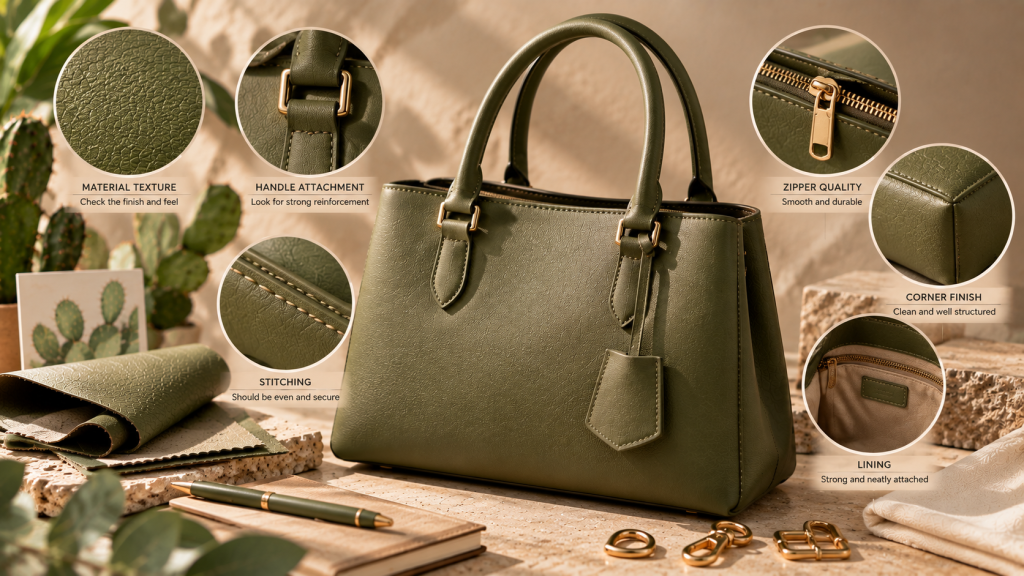
You can learn a lot from a simple physical inspection before buying a handbag.
First, gently bend a non-structural section of the material. It should flex according to its intended construction without obvious surface damage, excessive stiffness or sharp creasing.
Next, examine the edges.
Look at the corners, flap folds, zipper ends and handle attachments. These are the places where repeated flexing and stress can expose weaknesses in a poorly selected or poorly constructed material.
Then inspect the stitching.
The stitches should look consistent, secure and appropriate for the material thickness. Loose threads, uneven tension or visibly strained seams are warning signs regardless of whether the bag is vegan or traditional leather.
Finally, check the hardware.
Open and close the zipper several times. Move the clasp. Check the D-rings and handle connections. A handbag is a system, not just an outer shell.
Material testing guides for bag production similarly recommend testing the finished prototype because a flat material swatch cannot reveal what happens at seams, corners, handles, folds and hardware attachment points.
Does Price Tell You Whether a Vegan Leather Handbag Is Good?
Price is useful, but it should never be your only quality test.
As an indicative Indian retail range, vegan leather handbags can broadly sit around ₹4,000–₹15,000, with premium designs going beyond that depending on material, construction, hardware, brand positioning and finishing.
| Indicative retail level | Approx. price | What you should expect |
|---|---|---|
| Entry vegan handbag | ₹1,500–₹4,000 | Simpler construction, lighter hardware and more basic materials are common |
| Mid-range vegan handbag | ₹4,000–₹8,000 | Better construction, improved finishes and more considered hardware |
| Premium vegan handbag | ₹8,000–₹15,000 | More refined material, stronger construction, better hardware and finishing |
| Luxury / designer segment | ₹15,000+ | Price can reflect design, craftsmanship, limited production and brand positioning |
These are market-level indicative ranges, not ANOVYA quotations.
The important point is that paying ₹12,000 for a handbag does not automatically make it durable.
You are paying for a combination of material, design, craftsmanship, hardware, finishing and brand value.
Which Vegan Leather Material Should You Choose?
There is no single vegan leather material that suits every handbag.
The right choice depends on how you intend to use the bag.
| Use case | Material/construction priority | What to look for |
|---|---|---|
| Daily handbag | Flexibility + abrasion resistance | Strong backing and reinforced stress points |
| Office tote | Structure + load handling | Reinforced base and handle attachment |
| Small evening bag | Finish + shape retention | Refined surface and clean edge finishing |
| Travel handbag | Abrasion + hardware | Strong seams, durable zipper and reinforced handles |
| Lightweight sling | Flexibility + strap attachment | Secure strap anchors and suitable material thickness |
| Premium fashion bag | Material + finish + construction | Consistent texture, precise stitching and quality hardware |
This is where design and material need to work together.
A rigid material may work beautifully for a structured bag but feel uncomfortable in a soft, folded silhouette. A very soft material may look elegant but need additional reinforcement where the bag carries weight.
The best material is therefore the one that matches the design.
How Does Indian Weather Affect Vegan Leather Handbags?
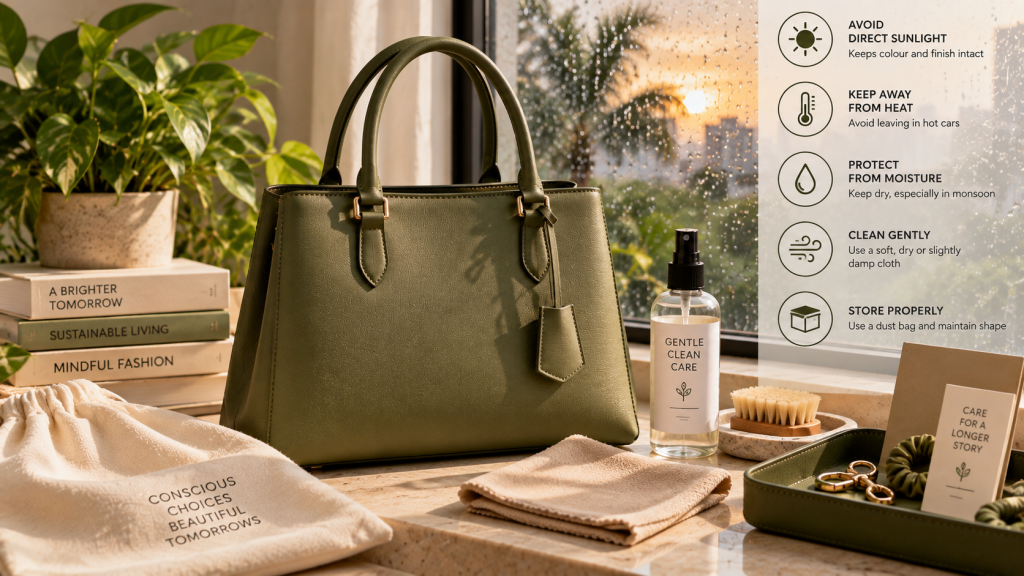
Heat, humidity, dust and direct sunlight are important considerations for Indian handbag buyers.
This does not mean every vegan leather handbag will fail in Indian weather. It means the material should be selected and cared for according to the environment.
Humidity and heat can be particularly relevant for some coated materials because degradation processes such as hydrolysis can affect certain polyurethane systems. Material construction and coating chemistry therefore matter.
For everyday use in India:
- Avoid leaving the handbag inside a hot car for long periods.
- Do not store it damp after exposure to rain.
- Keep it away from prolonged direct sunlight when not in use.
- Wipe surface dirt gently rather than using aggressive household chemicals.
- Follow the manufacturer’s specific care instructions.
- Store the bag with enough support to maintain its intended shape.
Delhi summer is not the same environment as a cool indoor wardrobe, and a handbag that spends hours in a parked car faces a different stress pattern from one carried occasionally to dinner.
That is why proper care is part of durability.
What Are the Biggest Signs of a Poor-Quality Vegan Handbag?
The biggest warning signs are usually visible around the stress points rather than the centre of the bag.
Watch for:
Peeling or bubbling:
The surface layer may be separating from the backing.
Sharp cracking when flexed:
A material that shows obvious surface cracking during normal movement deserves closer inspection.
Loose stitching:
Loose or inconsistent stitching can weaken the bag even when the outer material looks premium.
Weak handle attachment:
If the handles are attached only through a small, visibly stressed area, the design may not distribute load effectively.
Flimsy hardware:
A beautiful bag with poor zippers or clasps can become unusable because of one failed component.
Poor edge finishing:
Edges receive repeated friction and bending, so careless finishing can become an early wear point.
Strong unexplained chemical smell:
Odour alone does not establish quality, but an unusually strong smell combined with poor construction is worth treating cautiously.
The practical lesson is straightforward:
Do not inspect the bag only from the front. Turn it around, open it, bend the material gently and examine the places where force enters the construction.
How Should You Care for a Vegan Leather Handbag?
The correct care routine depends on the material, so always follow the manufacturer’s instructions first.
For general use, keep the routine simple.
Use a soft, dry or slightly damp cloth for ordinary surface cleaning when the care instructions permit it. Avoid soaking the handbag unless the manufacturer specifically states that the material is suitable for it.
Do not use leather conditioners designed specifically for animal leather unless the vegan material manufacturer recommends them.
For storage, maintain the bag’s shape without compressing it under heavy objects. Keep it in a dry, ventilated area away from prolonged direct sunlight.
If the bag becomes wet, allow it to dry naturally rather than applying direct high heat.
The objective is not to make the bag maintenance-heavy.
It is to avoid unnecessary stress that accelerates wear.
How to Choose a Vegan Leather Handbag for Everyday Use
For an everyday handbag, prioritise construction before decorative details.
A practical buying order is:
1. Material composition
Know what the outer material actually is.
2. Handle construction
Check where the load is transferred into the body of the bag.
3. Stitching
Look for consistent, secure seams.
4. Hardware
Test the zipper, clasp and strap attachments.
5. Base construction
A structured base can help the bag retain its form when carrying everyday items.
6. Surface finish
Choose a finish that suits how frequently you will use the bag.
7. Care requirements
Make sure the maintenance routine fits your lifestyle.
8. Price
Compare what you are actually receiving rather than comparing price tags alone.
This approach is more useful than simply searching for the “best vegan leather”.
Vegan Leather Handbag: What Should You Ask the Brand?
If the product page does not answer your questions, ask the brand directly.
A good material-focused question is:
“What is the outer material made from?”
Then ask:
- Is the material plant-based, synthetic or a combination?
- What type of backing does it use?
- What is the material thickness?
- What care products are recommended?
- Is the bag designed for everyday use?
- Are the handles reinforced?
- What hardware is used?
- How should the bag be stored?
- Does the brand provide repair or after-sales support?
A transparent answer is more useful than a generic statement such as “eco-friendly premium leather”.
Vegan describes the absence of animal-derived material. It does not, by itself, describe durability, environmental impact, construction quality or lifespan.
Is a Vegan Handbag Actually Worth Buying?
A vegan handbag can be a sensible choice when its material, construction and intended use match your expectations.
It is worth remembering that vegan does not automatically mean durable, plant-based or sustainable.
The opposite is also true: a vegan handbag should not be dismissed simply because older synthetic alternatives developed a reputation for peeling or cracking. Material technology and construction vary considerably between products.
The better buying decision comes from asking specific questions.
What is the material?
How is it constructed?
Where will the bag experience the most stress?
How will you use it?
How should it be maintained?
What happens if something goes wrong?
Once you start looking at a handbag this way, the buying process becomes much clearer.
Final Takeaway: How to Choose a Vegan Leather Handbag That Actually Lasts
How to choose a vegan leather handbag comes down to looking beyond the label.
Check the material composition. Inspect the backing and surface. Look carefully at handles, corners, seams, edges and hardware. Consider India’s heat and humidity. Read the care instructions. Then compare the price with the actual construction and craftsmanship.
A premium handbag should not need a sustainability story to hide weak construction.
The material story should be supported by a good product.
At ANOVYA, our approach to plant-based materials starts with that principle: the material matters, but so do design, finishing, construction and the experience of carrying the finished handbag.
If you are evaluating a vegan leather handbag, look at the whole product rather than the label. That is how you choose a bag with a better chance of staying part of your wardrobe for years rather than becoming another short-lived accessory.
FAQ
How do I choose a vegan leather handbag that lasts?
Start with the material composition, then inspect the backing, thickness, surface finish, stitching, handle reinforcement and hardware. For everyday use, pay particular attention to corners, seams and handle attachments because these areas experience repeated stress. A premium-looking surface alone does not tell you how the finished handbag will perform.
What is the most durable vegan leather for handbags?
There is no single material that is automatically the most durable for every handbag. Durability depends on the material formulation, backing, coating, thickness and construction. PU, microfiber and plant-derived materials can all perform differently. Look for information about abrasion, flexing, coating adhesion and the intended use rather than choosing solely from the material name.
How much does a good vegan leather handbag cost in India?
An indicative retail range for vegan handbags in India is roughly ₹4,000–₹15,000, while luxury designs can cost more. Price depends on material, construction, hardware, finishing and brand positioning. A higher price does not automatically guarantee better durability, so inspect the construction and material details before buying.
Does vegan leather peel?
Some vegan leather materials can peel or delaminate, particularly when the surface coating or bonding system is poorly suited to repeated flexing, heat or humidity. This is not an outcome that applies equally to every vegan material. Material quality, coating, backing, construction and care all influence the risk.
Is plant-based leather better than PU vegan leather?
Plant-based and PU are not always mutually exclusive categories. Some plant-derived leather alternatives use polymer binders or coatings. Therefore, “plant-based” does not automatically mean more durable or completely plastic-free. Check the complete material composition and the construction of the finished handbag before comparing the two.
How can I make my vegan leather handbag last longer?
Keep it away from prolonged direct heat and sunlight, avoid unnecessary moisture, clean it according to the manufacturer’s instructions and store it without excessive compression. Do not use animal-leather conditioners unless the manufacturer specifically recommends them. Regularly checking handles, corners and hardware can also help you catch wear early.
What should I check before buying a vegan leather bag?
Check the material composition, backing, thickness, surface finish, stitching, handle attachment, zipper, hardware, base structure and care instructions. If the brand provides material testing or performance information, look for properties such as abrasion resistance, flex resistance and coating adhesion. The finished bag should be judged as a complete product.