
What Is Cactus Leather? A Complete Guide to Cactus-Based Materials
Cactus leather is a leather alternative made from the mature leaves of the nopal cactus. The leaves are dried, milled and combined with a binder, then applied to a fabric backing to create a usable sheet. It is partly plant-based rather than fully plant-based, and its composition varies significantly between manufacturers.
That last sentence is the one most guides leave out, and it is the one that matters when you are deciding what to buy.
Where cactus leather came from
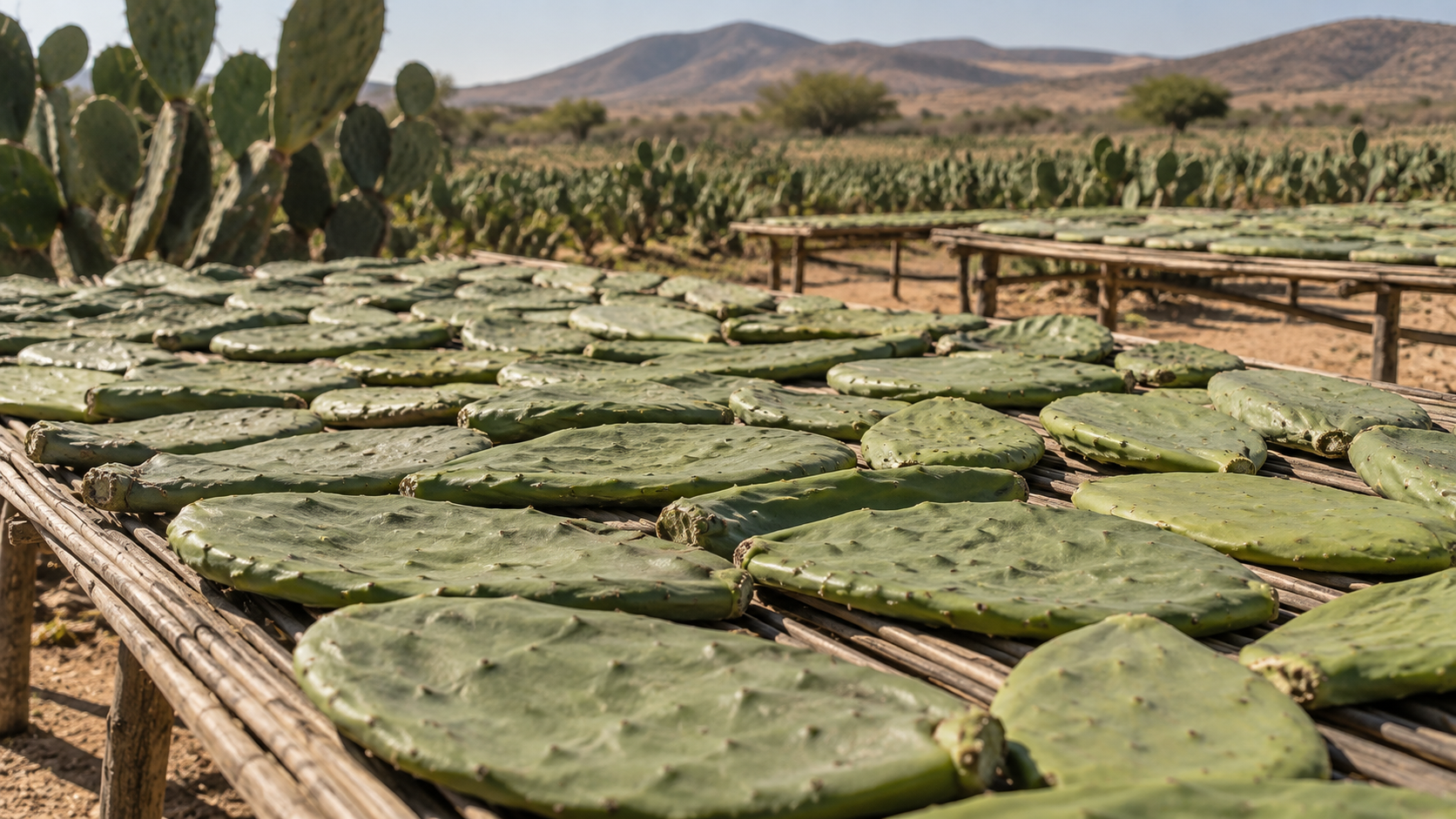
The material most people mean by cactus leather is Desserto, developed in Mexico by Adriano Di Marti and introduced to the market in 2019. It is made from the nopal cactus, also called prickly pear, botanically Opuntia ficus-indica, grown in the state of Zacatecas.
The choice of plant is not incidental. Nopal is native to the region, so it grows on rainfall and soil minerals without irrigation. It is perennial, which means only the mature leaves are cut while the plant stays in the ground and regrows. Published accounts of the process describe a harvest cycle of roughly six to eight months from the same plants, with a single plantation productive for around eight years. Cactus also grows on degraded land that would not support most other crops.
Several manufacturers now produce cactus-based materials. They are not identical, and the differences are not cosmetic.
How cactus leather is made
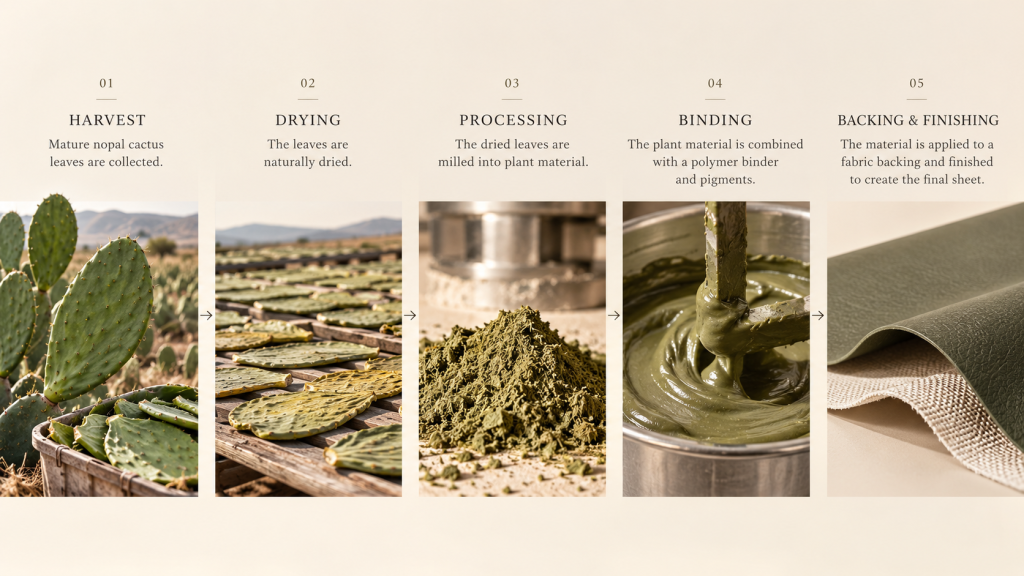
- Harvest
Mature leaves are cut. The plant is not removed or killed.
- Drying
The leaves are cleaned and sun-dried, commonly described as a three-day process, until the moisture content is right for milling.
- Processing
The dried material is milled into a fine powder or fibre.
- Binding
The plant material is combined with a polymer binder and pigments. This is what turns loose organic matter into a flexible, water-resistant sheet.
- Backing and finishing
The mixture is applied to a carrier fabric, usually cotton or recycled polyester, then embossed and finished to the required texture.
Steps one to three are the part the marketing usually shows. Steps four and five determine how the finished material performs, and how sustainable it actually is.
What cactus leather is actually made of
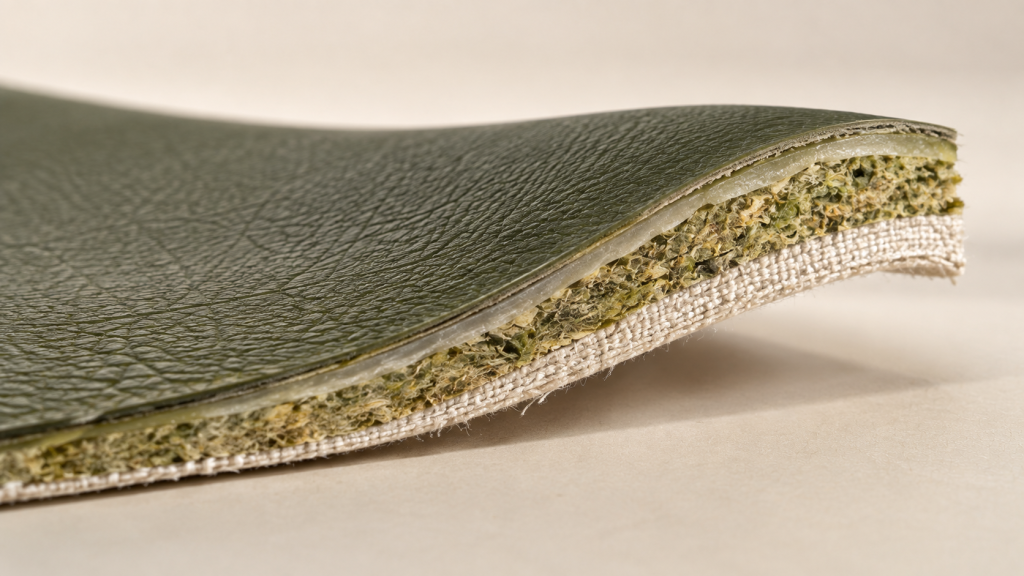
A cactus leather sheet is a composite. It has three parts.
The plant content
Milled nopal, which provides bulk, texture and the bio-based portion of the material.
The binder or coating
A polymer, in most commercial formulations a polyurethane, sometimes partly derived from plant oils. Without a binder the plant material would not hold together, flex, or resist water. This is the layer manufacturers disclose least, usually citing intellectual property.
The backing fabric
A woven or non-woven textile that gives the sheet its tensile strength. It may be cotton, recycled polyester, or a blend.
The practical takeaway
The word cactus describes an ingredient, not a specification. Two products both sold as cactus leather can differ in plant content, binder chemistry, backing fabric, thickness and finish, which means they can differ in how they wear, how they age and what happens to them at end of life.
Ask about the sheet. Not the plant.
How cactus leather feels and behaves
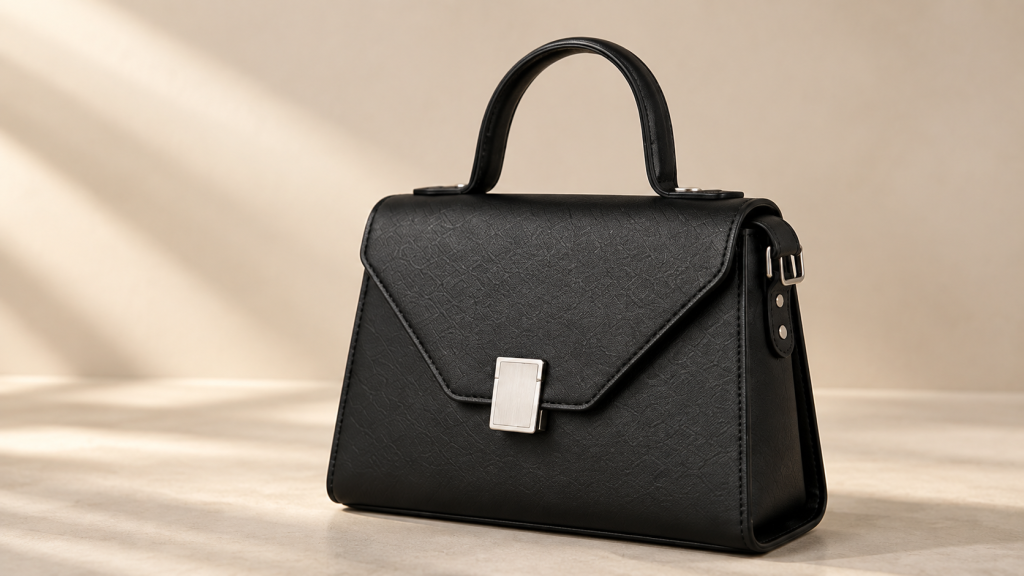
In the hand it is soft, noticeably lighter than a comparable weight of animal leather, and very consistent. There is no grain variation, no natural scarring, no difference between one panel and the next. Depending on your taste, that uniformity reads either as clean and modern or as slightly too perfect.
It does not develop a patina. Animal leather absorbs oils and darkens with use, and a lot of what people describe as leather ageing well is that process. A coated material does not do this. It stays close to how it looked on day one until the surface eventually shows wear, which is a genuinely different relationship with an object over time and worth knowing before you buy.
It handles rain and spills better than untreated leather, because the surface is sealed. It is less breathable for the same reason. It is more sensitive to sustained heat, sharp abrasion and folding at the same crease point over long periods, which is where surface cracking in coated materials usually begins.
Where cactus leather works, and where it is still developing
Handbags, totes and slings
Strong suitability. Moderate abrasion, with structural loads carried by construction and hardware rather than the material alone.
Wallets and small accessories
Strong suitability. Low abrasion. Repeated folding is the main stress point, managed through thickness selection.
Upholstery and interiors
Established. Large flat panels, controlled wear, and the category the founders originally came from.
Footwear uppers
In use, still maturing. Flex cycles and moisture exposure are far more demanding than bag applications.
High-abrasion technical use
Not the right material. Sustained scuffing wears through a surface coating faster than it wears into a hide.
Cactus leather compared with other vegan leathers
PVC
Base: Petroleum, chlorinated
Typical use: Low-cost fashion, bulk goods
Main limitation: Stiff, poor ageing, the most problematic end-of-life profile of the group.
PU
Base: Petroleum-based polymer on fabric
Typical use: The default for most products labelled vegan leather
Main limitation: No bio-based content, non-biodegradable, surface wear over time.
Cactus
Base: Nopal plus polymer binder on fabric
Typical use: Bags, accessories, interiors
Main limitation: Partly bio-based, not plastic-free, composition varies by supplier.
Other plant hybrids
Base: Pineapple leaf, apple or grape food waste plus binder
Typical use: Bags, footwear, accessories
Main limitation: Same binder question, different feedstock and hand feel.
Mycelium-based
Base: Grown fungal material
Typical use: Premium, limited production
Main limitation: Scale and cost, higher bio-content potential.
Classification note: PVC and PU are synthetic. Cactus and other plant hybrids are partly bio-based composites. None of the commercially available options in this table are entirely free of polymer content.
How to care for cactus leather
- Wipe with a soft, slightly damp cloth. Let it air dry away from direct heat.
- Skip solvents, alcohol wipes and conditioning products made for animal leather. There is no hide to feed, and oils can degrade a coated surface.
- Store stuffed and upright rather than folded. Coated materials crease at the fold.
- Keep it out of prolonged direct sunlight, which is what fades pigments over time.
- Deal with stains quickly. A sealed surface releases most marks easily when they are fresh.
What to ask before you buy a cactus leather bag
This is the checklist that separates a considered purchase from a marketing-led one.
- What is the bio-based content of the material?
A brand that knows will tell you. A brand that only says cactus is describing an ingredient.
- What is the binder?
Polyurethane is the honest answer for most formulations. Silence is informative.
- What is the backing fabric?
It affects strength and end of life.
- How is the bag constructed?
Stitch density, edge finishing, reinforcement at strap anchors and stress points. Most bags fail at seams and hardware, not in the middle of a panel.
- What hardware is used?
Zip quality and clasp weight tell you more about a bag’s lifespan than any material claim.
- Is the lining serviceable?
A well-made lining can be repaired. A glued one usually cannot.
- What does the brand say about limitations?
A brand willing to tell you what the material does not do is a brand that has actually tested it.
The honest limitations
It is not plastic-free. A polymer binder is present in commercial formulations.
Biodegradability claims should be read carefully. Partially biodegradable is not the same as compostable.
Long-term wear data is limited. The category has been in the market since 2019, which is not long enough for the twenty-year comparisons often made against animal leather.
It cannot be conditioned or refinished the way a hide can, so surface damage is generally permanent.
Composition varies. Any general statement about cactus leather, including the ones in this article, has to be checked against the specific material in the specific product.
Where ANOVYA sits
ANOVYA works with cactus-based materials because of what they allow in design: a lighter bag, a consistent finish across a collection, and a structure that holds its shape without the weight penalty that comes with hide.
We believe material choices should be understood beyond a label. Cactus-based materials are an evolving category, and their composition and performance can vary between manufacturers.
Our approach is simple: choose plant-based materials for their design and material properties, while being transparent about what we know and what we are still learning.
Frequently asked questions
Is cactus leather real leather?
No. Leather is tanned animal hide. Cactus leather is a plant-based composite designed to perform and look similar. Some regulators and the traditional leather industry object to the word leather being used for it at all.
Is cactus leather plastic?
Not entirely, and not nothing. Commercial cactus leather combines plant material with a polymer binder on a fabric backing. The proportions vary by manufacturer and are not always disclosed.
How long does a cactus leather bag last?
Longevity depends more on construction, hardware and use than on the material itself. Industry estimates for well-made coated plant-based materials generally sit in the mid single-digit to ten-year range with reasonable care. There is not yet enough field data for a firmer answer.
Does cactus leather peel?
Any coated material can eventually show surface wear at high-friction points such as corners, strap edges and base seams. Thickness, coating quality and how the bag is used all affect when.
Is cactus leather waterproof?
Water resistant, not waterproof. The surface handles rain and spills well. Seams, zips and lining are still the weak points in any bag.
Is cactus leather better than PU leather?
It has bio-based content that PU does not, and a farming stage with a genuinely lower impact. Both use polymer chemistry to reach a usable material. The comparison is covered in detail in the dedicated cactus leather versus PU leather guide.